Treachery as Cutter and the Tall Poppy Syndrome.

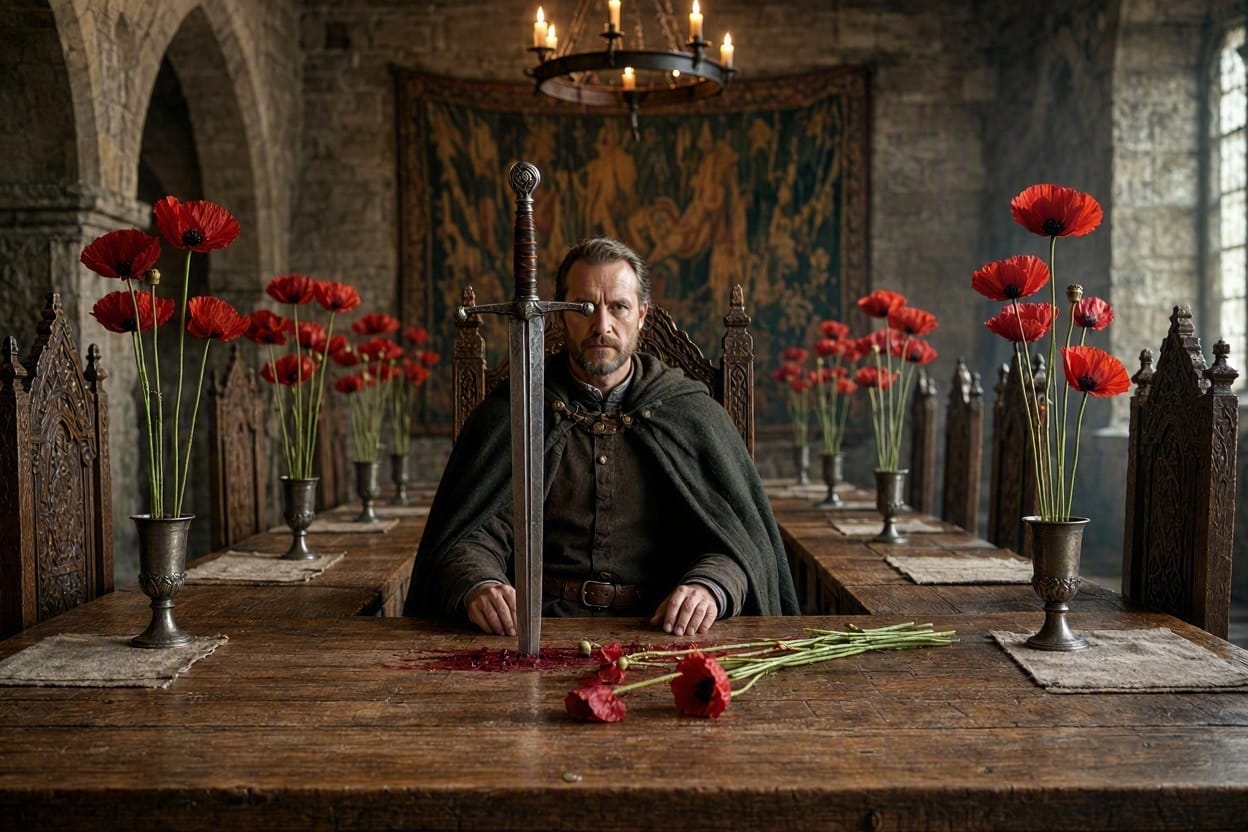
"Betray a friend, and you'll often find you have ruined yourself." ~ Aesop
I enjoy reading Dante because I consider him a kindred spirit. Our writings (his more so) are influenced by the Bible and the Seven Deadly Sins (see Dante, The Divine Comedy, and the Tall Poppy Syndrome and The Tall Poppy Syndrome & The Seven Deadly Sins).
Treachery is the deliberate betrayal of trust and loyalty. It breaks the social bonds that hold families, friends, and nations together. Unlike sins driven by sudden passion or anger, treachery is cold and calculated. It uses a victim's genuine love and faith as a weapon against them.
Dante encountered treachery in his friends, enemies, and the Pope early in his career. Treachery was involved in his permanent exile from Florence. Perhaps this explains why Dante considered treachery the worst sin (in the Circle of Hell), while the seven deadly sins were less consequential.
The Ninth Circle of Hell involves a large frozen lake, Cocytus. Trapped in the ice, each according to guilt, are sinners guilty of treachery against those with whom they had special relationships. The lake is divided into four concentric rings or circles of traitors, according to the seriousness of their betrayal: family ties, community ties, guests, and lords.
The cruel, cold-hearted dead center of the ice conveys their natures. Since they denied God's love, they are furthest from the light and warmth of His Sun. They denied human bonds and are now bound only by the unyielding ice (see John Winthrop, Tall Poppies, and the Tall Poppy Syndrome).
Circle 1 (Traitors to their Kindred) was named after Cain, who killed his brother, Abel (Genesis 4:8) due to bad envy and anger when God picked Abel's gift over his (see The Tall Poppy Syndrome - The Joy of Cutting Others Down).
Circle 2 (Traitors to their Country) was named after Antenor, a Trojan soldier who betrayed his city to the Greeks. This circle includes Bocca degli Abati, a traitorous Guelph of Florence.
In the mid-13th century, the Guelphs held sway in Florence while the Ghibellines controlled Siena. The feud ended in the Battle of Montaperti (September 1260). Bocca degli Abati, a Florentine knight fighting on the Guelph side, joined the Ghibelline cause by charging the standard-bearer of the Florentine cavalry and cutting off the hand that held the Florentine battle flag. This caused confusion, which triggered events that led to the Florentines being routed in one of the bloodiest battles fought in medieval Italy, with more than 10,000 fatalities.
Dante fought with the Guelph cavalry at the Battle of Campaldino (June 1289). In March 1302, Dante, betrayed by many, was condemned to exile.
Circle 4 (Traitors to their Lords) was named after Judas Iscariot, who betrayed Jesus for a bribe of thirty pieces of silver (greed).
In the very center of Hell, condemned for committing the ultimate sin (personal treachery against God), is the Devil. The arch-traitor, Lucifer, was once the most favored of the angels before his pride led him to rebel against God, resulting in his expulsion from Heaven.
Circle 3 (Traitors to their Guests) was named after Ptolemy:
History of Israel (167 - 37 BC)
The Maccabean Revolt (167-160 BC) was a Jewish rebellion against Syrian-Greek rule that successfully established the Hasmonean Dynasty, a self-governing Jewish kingdom that ruled Judea from 140 BC to 37 BC.
The revolt began as a clash over religious freedom and cultural assimilation. The Seleucid (Syrian-Greek) King Antiochus IV Epiphanes banned Jewish practices, desecrated the Second Temple in Jerusalem, and forced Hellenization (Greek culture) on the population.
In the town of Modi'in, an elderly priest named Mattathias refused to offer a pagan sacrifice, killed a royal official, and fled to the hills with his five sons. Mattathias's son, Judas Maccabeus ("The Hammer"), took command. He utilized brilliant guerrilla tactics to repeatedly defeat much larger, heavily armed Seleucid armies.
In 164 BC, Judas recaptured Jerusalem and purified the Temple. The miraculous eight-day burning of the Temple menorah during this rededication is celebrated today as the holiday of Hanukkah.
Following the revolt, the family of Mattathias (known as the Hasmoneans) gradually transitioned from military rebels to rulers of an independent nation. In 140 BC, Simon Maccabee (the brother of Judas) officially secured complete independence from the Seleucids and was declared High Priest and Ruler of Judea (The Hasmonean Dynasty, 140–37 BC)
Ptolemy, son of Abubus, was the military governor of Jericho who orchestrated the infamous betrayal and murder of his father-in-law, the Jewish High Priest Simon Maccabee, and two of his brothers-in-law (Mattathias and Judas) during a feast in 135 BC.
Appointed by Simon as the commander of the plain of Jericho, Ptolemy grew wealthy and arrogant. He harbored ambitions of taking over the Judean region and sought to eliminate the ruling Hasmonean family to achieve independence and power.
Ptolemy invited Simon and his sons to the fortress of Dok (also called Dagon) near Jericho. He received them under the guise of hospitality and hosted a lavish banquet. After the men had drunk heavily and became inebriated, Ptolemy and his hidden conspirators emerged with weapons and slaughtered Simon and his two sons.
Ptolemy also dispatched assassins to kill Simon's third son, John Hyrcanus (who was in Gazara), but the plot failed. John survived to take control of Jerusalem and laid siege to Ptolemy's fortress at Dok. When Ptolemy threatened to kill John's mother (whom he was holding captive), the siege was ultimately unsuccessful, though Ptolemy murdered his mother-in-law anyway before fleeing into exhile.
Ptolemy committed the ultimate violation of a guest—murder— his betrayal now famously immortalized in Western literature.
Under leaders such as John Hyrcanus and Alexander Jannaeus, the kingdom aggressively expanded its borders to closely match those of the ancient biblical kingdoms.
Internal conflicts eventually tore the dynasty apart. A bitter civil war between two royal brothers, Hyrcanus II and Aristobulus II, led both factions to seek Rome's help.
The Roman general Pompey the Great took advantage of this weakness, invading Jerusalem in 63 BC. Rome transformed Judea into a client state, eventually replacing the Hasmoneans with Herod the Great in 37 BC.
It should be noted that treason is not an insular sin. Some of the deadly sins of envy, anger, pride, greed, and lust are often the roots or anchors. Like any form of revenge, the betrayer should did two graves.
"Though those that are betray'd do feel the treason sharply, yet the traitor stands in worse case of woe."
~ Shakespeare

Tall Poppy Syndrome Newsletter
Join the newsletter to receive the latest updates in your inbox.