"Blue", the Kennedy Center, and the Tall Poppy Syndrome.

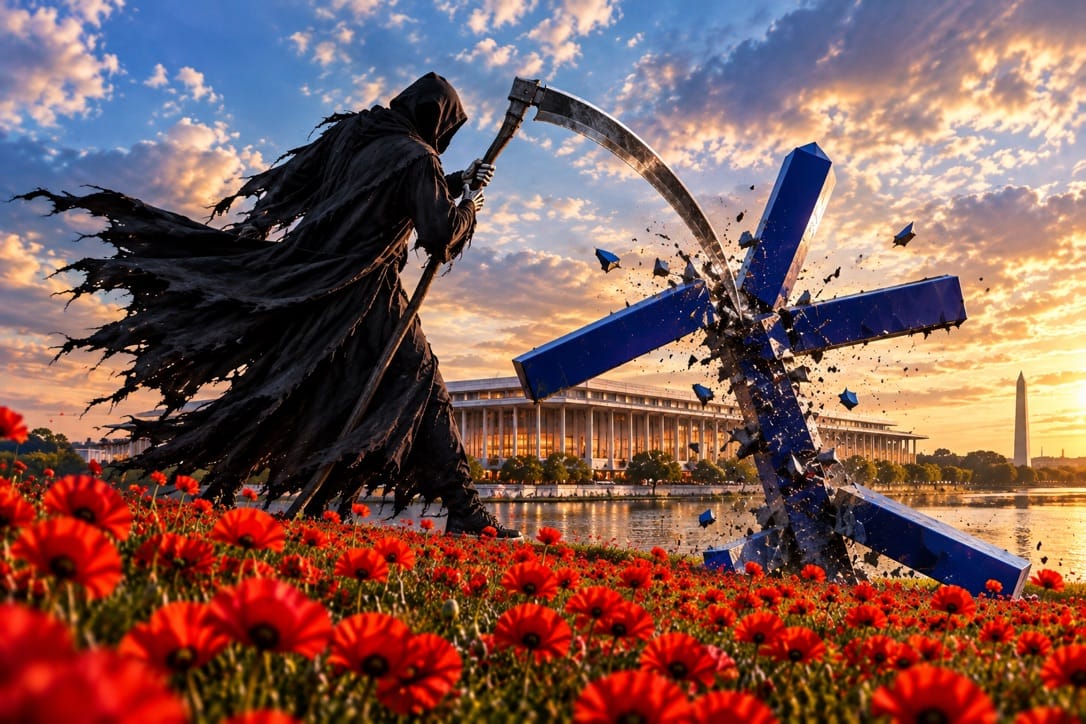
Art is not what you see, but what you make others see.
~ Edgar Degas
Government, for the most part, seems to receive a pass when discussing TPS. Governments are a major force in cutting people down. People "get it" when the "isms" are discussed, like communism or Marxism (see Navalny-Skripal-Prigozhin: Courage and the Tall Poppy Syndrome), but surely not democracies.
Our government, especially its three-letter agencies, is one of the biggest cutters in the USA and is so involved that I devoted an entire chapter in my book The Tall Poppy Syndrome - The Joy of Cutting Others Down.
Nazi “Degenerate Art”
In 1937, Nazi Germany launched one of the most notorious attacks on modern art in history. The Nazi regime called the art it rejected “Entartete Kunst,” or “Degenerate Art.” The term was deliberately derogatory. It was used to describe modernist and avant-garde works that the regime considered incompatible with Nazi racial, cultural, and political ideals.
The campaign grew out of Adolf Hitler's belief that art should serve the purposes of the German nation and reflect what the Nazis regarded as racial purity, physical strength, heroism, and traditional German values. Hitler personally disliked much of modern art. He favored highly realistic, monumental works depicting idealized human bodies, heroic historical scenes, landscapes, and classical themes. Modernist movements—including Expressionism, Cubism, Dada, Surrealism, and abstraction—were attacked as evidence of cultural decline.
The Nazis also connected modernism to antisemitism and their broader racial ideology. Jewish artists and dealers were particularly targeted, but the campaign affected many non-Jewish artists as well. Artists such as Paul Klee, Wassily Kandinsky, Ernst Ludwig Kirchner, Emil Nolde, Max Beckmann and Otto Dix found their work condemned or removed from German museums. Some were prohibited from exhibiting or teaching; others left Germany or withdrew from public artistic life.
The campaign reached its dramatic climax in July 1937, when the Nazis opened the exhibition Entartete Kunst in Munich. The Nazis displayed more than 600 works in deliberately chaotic, overcrowded rooms. They hung paintings at awkward angles, often accompanied by mocking slogans and captions criticizing their supposed artistic and political failures. The exhibition was designed not to encourage serious discussion of modern art but to ridicule it and persuade the public that modernism represented cultural corruption.
The exhibition was enormously successful as propaganda. More than two million people visited the Munich exhibition during its run, and it subsequently traveled to other German cities. At the same time, the Nazis mounted a very different exhibition—the Great German Art Exhibition—featuring works that conformed to their preferred aesthetic. The contrast was intentional: traditional, realistic and heroic art was presented as the healthy expression of Germany, while modern art was portrayed as pathological and destructive.
The Degenerate Art campaign was not merely a dispute about artistic taste. It was part of the Nazi regime's broader effort to control German culture and determine what Germans were permitted to see, read, hear, and create. Museums were purged, artworks were confiscated, and artists faced professional restrictions. Approximately 20,000 works from German museums were ultimately confiscated as “degenerate.” Some were sold abroad for foreign currency; others were destroyed.
The campaign also had consequences far beyond Germany. Many artists and intellectuals emigrated, carrying modern European art into Britain, the United States and elsewhere. The destruction and dispersal of works helped transform the international art world. Ironically, the Nazis' attempt to suppress modernism could not prevent it from becoming one of the defining artistic traditions of the twentieth century.
Today, Degenerate Art is remembered as a powerful example of how an authoritarian government can use cultural policy as an instrument of political control. The Nazis did not simply say that they disliked certain paintings. They attempted to establish an official definition of what art was allowed to be—and to punish (tall poppy) artists, museums and audiences who fell outside that definition.
The episode ultimately illustrates a larger point: when a government claims the authority to decide which ideas, styles and forms of expression are culturally legitimate, artistic judgment can become an instrument of political repression (TPS).
The Kennedy Center
The story of the John F. Kennedy Center for the Performing Arts began before John F. Kennedy's presidency. In the 1950s, President Dwight D. Eisenhower promoted the idea of creating a national cultural center in Washington, D.C., that would bring major performing arts to the nation's capital. Congress passed the National Cultural Center Act in 1958, establishing the foundation for the project.
After Kennedy became president, he and First Lady Jacqueline Kennedy supported the project and helped make the arts a prominent part of the national conversation. Following Kennedy's assassination in 1963, Congress renamed the planned institution the John F. Kennedy Center for the Performing Arts, making it a living memorial to the president.
President Lyndon B. Johnson broke ground in December 1964. Designed by architect Edward Durell Stone, the enormous white-marble structure was built on the Potomac River, near the Lincoln Memorial. It officially opened on September 8, 1971. The inaugural season included performances by major American artists, including the Alvin Ailey American Dance Theater.
From its beginning, the Kennedy Center was conceived as more than a single theater. It became a national performing-arts complex encompassing opera, ballet, theater, classical music, jazz, dance, and other forms of performance. The National Symphony Orchestra became an artistic affiliate, and the Center eventually developed extensive education and community programs.
One of its most visible traditions began in 1978, when the Kennedy Center inaugurated the Kennedy Center Honors, recognizing artists for their lifetime contributions to American culture. Over the decades, the Center expanded its facilities and programming, including the Millennium Stage, which began offering free performances in 1997, and The REACH, an expansion devoted to artistic creation, education, and public engagement that opened in 2019.
The Kennedy Center therefore has a distinctive place in American history. It began as Eisenhower's vision for a national cultural center, became a Kennedy memorial after his assassination, and evolved into one of the country's most prominent performing-arts institutions. Its history also reflects a broader American idea: that the performing arts can serve not simply as entertainment, but as part of the nation's civic and cultural life.
Joel Shapiro
Joel Shapiro (1941–2025) was an American sculptor whose career transformed the possibilities of figurative sculpture. Born in New York, he studied at New York University and spent time in India with the Peace Corps before joining the New York art world in the 1960s. His early work was associated with Minimalism, but he soon moved away from its strict geometric language toward sculpture that suggested human presence, movement, and emotion.
Shapiro became especially famous for his simplified human figures constructed from geometric blocks and bars. Although they look almost like children's stick figures, their poses can convey remarkable energy—walking, falling, dancing, jumping, or struggling. Shapiro deliberately left out conventional details such as faces and anatomy. The viewer therefore supplies much of the personality and emotion. His sculptures occupy the space around them rather than simply representing a person.
His work increasingly became monumental and public. Among his important commissions was Loss and Regeneration, installed at the United States Holocaust Memorial Museum in Washington, D.C. His sculptures also appear in major museums and public spaces worldwide, including the Metropolitan Museum of Art, the Museum of Modern Art, the Whitney Museum, the Tate, and the Center Pompidou.
Blue
One of Shapiro's most recognizable public sculptures was Blue, installed at the Kennedy Center's REACH in 2019. The tall blue figure appears caught in a moment of extraordinary physical movement—almost as though it has just kicked a ball or is about to. Shapiro described the work in terms of “action and risk and performance and energy.”
That makes Blue particularly characteristic of Shapiro's art: a few simple geometric pieces become a human being in motion. The sculpture is abstract, but unmistakably human.
In September 2026, Blue became part of the controversy surrounding changes at the Kennedy Center when it was dismantled and removed from the REACH grounds. The Center said it removed the work at its request (doublespeak) and expressed appreciation for Shapiro's contribution.
The Kennedy Center is currently closed to the public. On September 16, the Center announced an immediate temporary closure because its executive director described acute public-safety risks tied to structural deterioration, including a partial ceiling collapse and problems with the roof terrace canopy.
Separately, the Trump-aligned board voted to close the main complex for an extensive renovation estimated at about $257 million, with a proposed closure of roughly two years. The board says major structural, electrical, plumbing, fire-safety, and theater renovations are necessary.
The closure is now tied up in federal litigation. On September 17, Judge Christopher Cooper ordered the Kennedy Center to give 30 days' notice before making major physical changes to the building, including demolition. That order came amid the dispute over whether the board can proceed with its proposed closure and renovation plans.
The Center, closed and fenced off, also faces an unresolved dispute over its name. A federal judge previously ordered that Donald Trump's name could not be added to the Kennedy Center's official name, while the board has continued pursuing changes to the building's identification. A Trump social media post claimed the funds will not be available unless they add Trump's name to the facade.
Blue is no longer at the Kennedy Center. The 24-foot-tall blue aluminum sculpture was dismantled on September 2, 2026 (tall poppied).
David Rubenstein, the former Kennedy Center chairman, purchased Blue from the Joel Shapiro and Ellen Phelan Foundation. The sculpture is expected eventually to be displayed in the Sculpture Garden of the National Gallery of Art in Washington. The reported purchase price was more than $2 million, although the exact terms have not been publicly confirmed.
Blue, like many TPs, is already growing taller (see The Resilient Poppy). It has become a cause celebre and is now more widely recognized. The Kennedy Center's fate is still unknown. Now it is in the hands of politicians making its outcome less predicable. Like Blue and the Phoenix of Greek mythology, I predict it will soar to greater heights.
illegitimi non carborundum

Tall Poppy Syndrome Newsletter
Join the newsletter to receive the latest updates in your inbox.