Carl Sagan, Harvard, and Peer-to-Peer Tall Poppy Syndrome.


It is in the character of very few men to honor without envy a friend who has prospered. Aeschylus
Ancient periods described the Tall Poppy Syndrome (TPS) as a means of cutting down political opposition (see Livy, Tarquin the Proud, & The Tall Poppy Syndrome). More recently, Australians have described TPS as cutting down people of stature, fame, or fortune to ensure equity (see The Tall Poppy Syndrome - The Joy of Cutting Others Down).
We have taken a different approach to the TPS metaphor and detailed that it is a broad-based psychosocial phenomenon driven predominantly by the dark emotions of the seven deadly sins (see The Tall Poppy Syndrome & The Seven Deadly Sins).
More importantly, we divided TPS into private (peer-to-peer) and public. Private TPS is the most common, yet the least recognized, and does not necessarily involve tall poppies (TPs); rather, it involves your tribe (small or tall)—family, friends, neighbors, schoolmates, and workplace associates. The dark emotions are often found in the cutter.
Public TPs follow the more traditional Australian concept, but we have also emphasized that many TPs have acted egregiously, and the public feels justified in cutting them down (see Anatomy of the TALL POPPY SYNDROME). The dark emotions are often found in the TP.
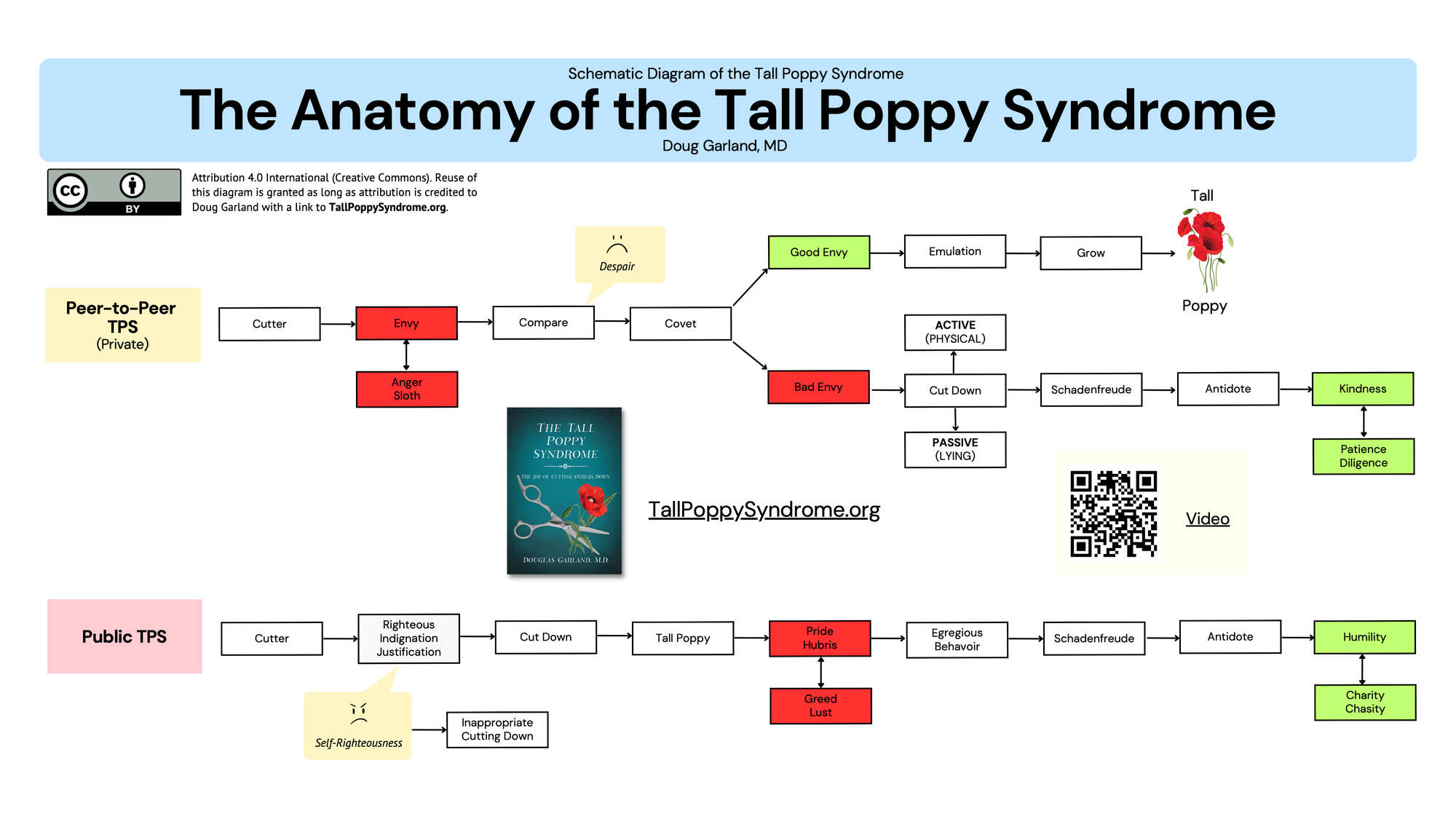
Universities are hierarchies and, as such, are breeding grounds for TPS (see Katalin Karikó, The Nobel Prize, & The Tall Poppy Syndrome and Hypocrisy, Harvard, Francesca Gino, and the Tall Poppy Syndrome). These instances are frequently institutional (private TPS): TP vs TP, especially when the golden goose—tenure—is at stake.
Carl Sagan’s story begins in Brooklyn, New York, where he was born in 1934 to a working-class Jewish family. As a boy, he was fascinated by science fiction, astronomy, and the possibility of other worlds beyond Earth.
He attended the University of Chicago, where he studied science broadly rather than confining himself to a single discipline. He earned degrees in physics and later completed graduate work in astronomy and astrophysics. At Chicago, he came under the influence of scientists who were beginning to think seriously about planetary science, the origin of life, and the possibility of extraterrestrial biology.
Sagan’s early scientific work already displayed the characteristic combination that would later define him: rigorous physical reasoning coupled with enormous imaginative reach. He investigated planetary atmospheres and the conditions under which life might arise. His research helped establish the idea that planetary environments could be understood as physical systems with histories of their own.
One of his early interests was Venus. Before spacecraft had visited the planet, there was considerable speculation that Venus might be a warm, perhaps even habitable, world. Sagan argued otherwise. He recognized that Venus's dense carbon-dioxide atmosphere could produce an extreme greenhouse effect, making the planet far hotter than its distance from the Sun might suggest. Later spacecraft observations vindicated the basic picture.
He also became interested in Mars and in the possibility that its surface might harbor life. Sagan did not simply accept the romantic idea of Martian canals or vegetation, but he did not dismiss the question either. Instead, he helped transform the question from science fiction into a legitimate scientific problem: What would life elsewhere actually look like, and how could we detect it?
By the time Sagan began his professional career, he was already thinking across boundaries—astronomy, biology, chemistry, planetary science, and the emerging field of space exploration. His ambition was not merely to understand individual planets but to understand the relationship between life and the cosmos.
Sagan arrived at Harvard in the early 1960s, at a moment when American astronomy and space science were expanding rapidly. He became associated with the Smithsonian Astrophysical Observatory and the Harvard astronomy community, working on planetary atmospheres, the origins of life, and the emerging science of planetary exploration.
Harvard offered Sagan an extraordinary intellectual environment, but it also exposed one of the tensions that would follow him throughout his career. Sagan was an unconventional scientist. He was deeply serious about research, but he was equally interested in communicating science to the public. He believed that the discoveries of astronomy belonged not only to specialists but to everyone.
This conviction made him unusually effective at explaining difficult ideas. He could take an obscure scientific question—how planets evolve, how life might arise, what an alien civilization might be like—and turn it into a question that felt personally meaningful.
He also became increasingly involved with the American space program, contributing concepts about the environments of other planets and serving as a scientific participant in the exploration of the Solar System. He was involved in the intellectual foundations of missions to Mars and Venus and in the broader effort to determine whether life might exist elsewhere.
However, his ability to communicate was becoming almost as notable as his scientific work.
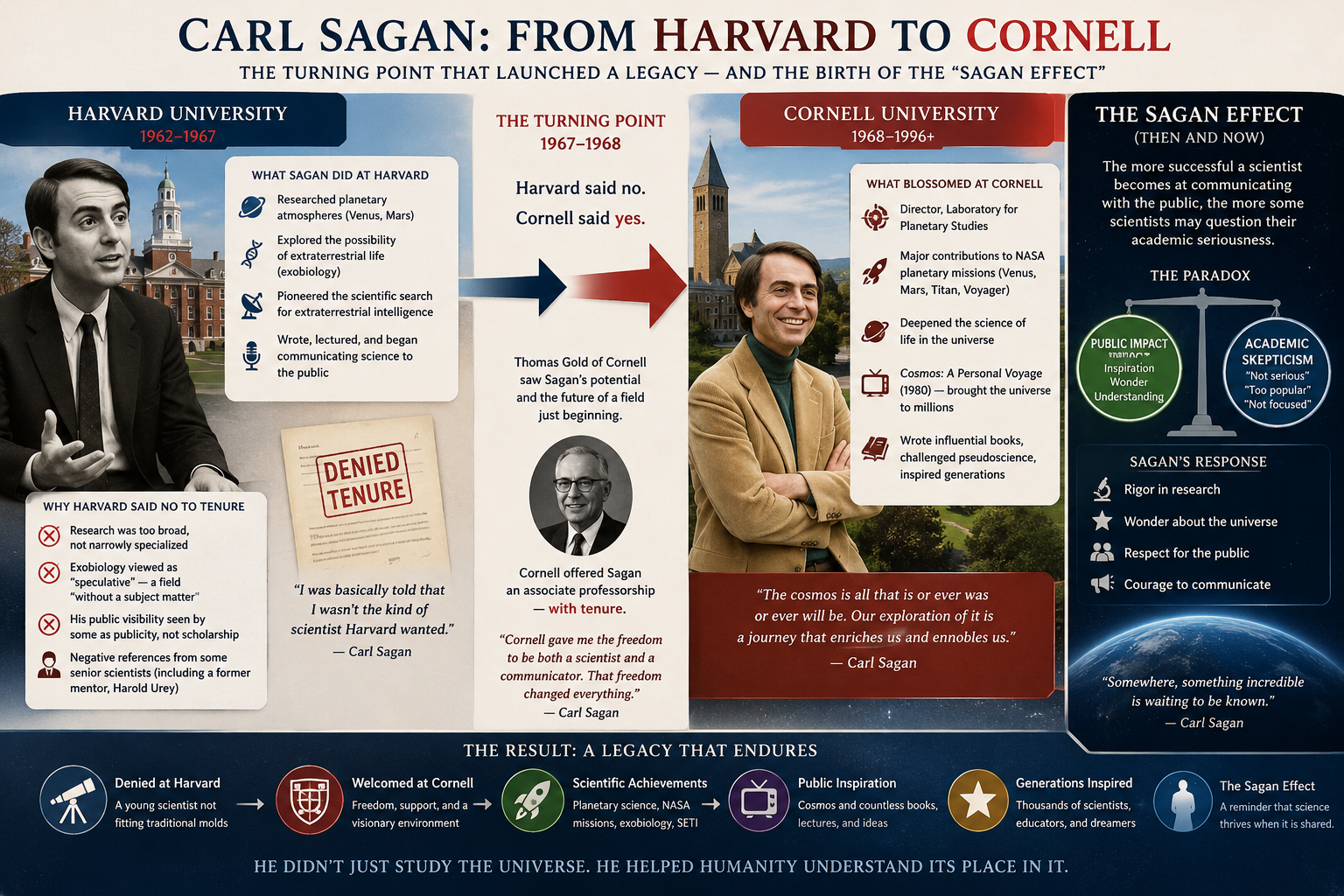
Harvard became an uncomfortable institutional home for him. He was becoming a very public scientist. His lectures, writing, and media appearances made him unusually famous for a young academic. Some colleagues apparently regarded this as evidence that he was more interested in publicity than conventional academic research (malignant envy).
Harvard denied his tenure (tall poppied). There was opposition from some senior scientists. Sagan later discovered that Harold Urey, one of his former mentors at the University of Chicago, had supplied negative references concerning his work to Harvard and MIT. Urey subsequently apologized and acknowledged that he had been wrong.
Cornell's Thomas Gold immediately saw an opportunity. Gold was building Cornell's astronomy and space-research program and recruited Sagan, offering him an associate professorship with tenure. Sagan accepted, and Cornell formally appointed him in January 1968.
Cornell turned out to be the perfect environment for Sagan. There, he developed the Laboratory for Planetary Studies, became deeply involved in NASA's planetary missions, and eventually gained the institutional freedom to become both a major scientist and the world's most recognizable science communicator. NASA describes his contributions to Venus, Mars, and Titan as major scientific achievements, as well as his enormous role in popularizing science.
Sagan found an institution where his interests could flourish. He became a professor of astronomy and director of Cornell's Laboratory for Planetary Studies. There he built a career that combined planetary science, space exploration, scientific skepticism, and public communication on a scale few scientists had achieved before or since.
Cornell became Sagan's intellectual base for more than two decades.
The Sagan Effect describes a recurring conflict (TPS) in science—the more successful a scientist becomes at communicating with the public, the more some professional scientists may regard that public visibility as evidence that the scientist is becoming less serious academically.
He published significant scientific research, contributed to planetary exploration, advised NASA, helped shape the scientific discussion surrounding extraterrestrial life, and held a prestigious professorship at Cornell. Yet his extraordinary success as a communicator sometimes worked against him within parts of the scientific establishment.
There is an implicit hierarchy in academic culture. Research papers, technical specialization, grants, conferences, and citations are considered the traditional measures of scientific achievement. Television appearances, popular books, public lectures, and media interviews could be viewed as distractions—or even as signs of celebrity replacing scholarship.
Sagan challenged that hierarchy simply by being exceptionally good at both. His approach was particularly important because he did not treat the public as intellectually inferior. His career therefore created an unusual paradox.
In 1980, Sagan became the host and writer of Cosmos: A Personal Voyage, the landmark television series that brought astronomy and the history of science into millions of homes. The series presented the universe not as a collection of facts but as an adventure in human understanding.
The irony is that Sagan's public work has arguably become his most enduring scientific legacy. Generations of scientists have cited Cosmos as an inspiration for entering astronomy, physics, planetary science, biology, and space exploration.
He demonstrated that a scientist could conduct serious research, participate in cutting-edge space exploration, think philosophically about humanity's place in nature, challenge pseudoscience, search for extraterrestrial intelligence, and still speak to millions of people in language they could understand.
The Sagan effect contains a warning, but also a challenge. If scientists retreat entirely into specialized communities, the public conversation about science may be left to others. But if scientists become public communicators, they risk being judged by a culture that sometimes treats communication as secondary to research.
The Sagan effect, a form of TPS, is a consequence of being a TP, with all its reverberations, both positive and negative (see Rising Above the Scythe: A Guide to Recovery and Resilience After Tall Poppy Syndrome).

Tall Poppy Syndrome Newsletter
Join the newsletter to receive the latest updates in your inbox.