Rising Above the Scythe: A Guide to Recovery and Resilience After Tall Poppy Syndrome.


Understanding why things happen the way that they do makes you better prepared to face them. Mitta Xinindlu
Understanding the Anatomy of the Cut-Down
The Tall Poppy Syndrome (TPS) is not merely a source of social friction but also a "mediocre maintaining mechanism." It is a systemic drive to enforce equality by destroying excellence. The metaphor is ancient, yet its application is immediate: visualize a field of poppies where any flower blooming higher than the rest is summarily lopped off to preserve a uniform, average horizon.
While many attribute the origin of this metaphor solely to poppies, historical accuracy is vital to understanding the evolution of the "cut-down." The Greek historian Herodotus (430 BC) first described this behavior with wheat, in which a tyrant signaled his peer to "lop off the tallest ears" of grain to neutralize opposition. It was the Roman historian Livy (29–27 BC) who first explicitly associated the metaphor with poppies, recounting how Tarquin the Proud struck off the heads of the tallest flowers in his garden to communicate that the most prominent men in a rival city must be eliminated.
Categorizing the Experience
The trauma of being "cut" manifests differently depending on your environment. You must distinguish between these two spheres to tailor your recovery:
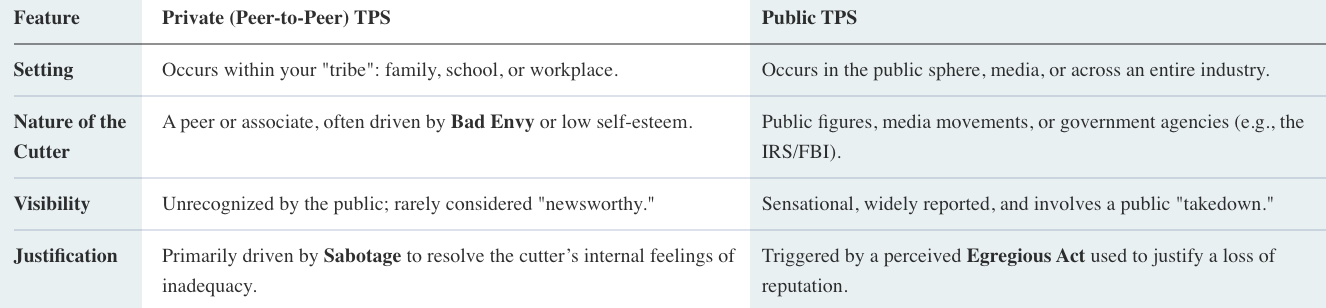
The Concept of Deservingness
Based on Dr. Norman Feather's research, we recognize that cutters rarely see themselves as villains. Instead, they operate under "righteous indignation." In the public eye, the cut-down is framed as a restoration of moral balance. If a community believes a person is "unworthy" due to perceived arrogance or a windfall, the subsequent attack is viewed not as a crime, but as a deserved "comeuppance."
The Emotional Landscape: Identifying Dark Emotions
To recover, you must first deconstruct the psychological machinery of your attacker and honestly audit your own conduct.
The Cutter’s Mindset
The drive to cut you down is fueled by three primary "dark emotions":
- Hostile (Bad) Envy: the core driver. Unlike "good envy," which motivates self-improvement, hostile envy seeks to eradicate the target's happiness or success.
- Anger: A reactive force triggered when your height is perceived as a direct threat to the cutter’s status. (Resentment: A complex, slow-burning bitterness toward your innate qualities or achievements, which often includes anger.)
- Sloth (Laziness): The cutter finds it easier to lower their height than to put in the labor required to grow as tall as they are.
The Tall Poppy’s Role
Victims must perform a rigorous self-audit—Did you inadvertently provide the "fertilizer" for your own cut-down? While the cutter is the aggressor, public "righteous indignation" is often triggered by these "four sins":
- Pride (Hubris): Excessive confidence or an air of invincibility.
- Greed: A self-serving pursuit of wealth at the expense of the collective.
- Lust: An overwhelming craving or desire, especially a powerful physical or sexual appetite, that compromises your integrity.
- Gluttony: A behavior or habitual pattern of "overindulgence" of the above three emotions, rather than a distinct primary emotion
If you exhibit any of these, the community views your fall as a "moral dessert," rewarding the cutter for "policing" the social order (see below).
You might have noticed that we identified seven common underlying offenders of TPS, which are known as the Seven Deadly Sins, and your mnemonic. The foundational treatment is their antedotal virtues. For example, the virtuous antedote for bad envy is kindness.
The Aftermath: Schadenfreude
Schadenfreude—joy derived from another's misfortune—is the emotional reward for the cutter. When you are cut down, the surrounding community often takes joy in it, feeling a temporary relief from their own feelings of inadequacy and elevating self-esteem.
Epicaricacy is the direct English equivalent of schadenfreude but without the cachet. When the combined entities of TPS and schadenfreude are driven by a single event, I have labeled the resulting phenomenon the tall poppy syndrome complex.
This distinction carries malignant connotations because the cutter initiates the cutdown and takes schadenfreude, which boosts self-esteem, unlike the benign example of someone slipping on a banana peel, where the observer plays no part in cutting the person down and instead offers a sheepish smile.
Immediate Psychological Recovery Strategies
Applying the 5 by 5 Rule
When you are in the "emotional squall" of a tribal conflict—such as the "Upset Teacher" scenarios seen in advice columns like Ask Amy—you must employ the 5 by 5 Rule: If the situation will not matter in five years, do not spend more than five minutes being devastated by it. This is a vital tool for emotional regulation, preventing you from wasting life-force on temporary tribal grievances.
The "Moving Your Cheese" Mindset
In my own career, after 30 years of service and international recognition, I arrived at work to find a note informing me my office had been moved to a "cubby hole." This was a clear signal that my"cheese had moved."
Actionable Advice: When an environment becomes toxic, and peers are actively blocking your light, you must be prepared to resign and pivot. Do not fight for a "cubby hole." Relinquish the contested status and move to a new environment where growth is welcomed. Recovery is found in flourishing, where your excellence is a valued asset rather than a target.
Managing Psychological Reactance
Beware of the "Streisand Effect"—a form of psychological reactance in which an attempt to censor or hide something leads to massive public awareness. When Barbara Streisand sued to remove a "public record" photo of her home, she turned six previous downloads into 420,000 new ones. Attempting to litigate or "hide" a perceived ill only increases its visibility. Instead of reacting, focus on your next cycle of growth.
Virtuous Antidotes: Neutralizing the Dark Emotions
Excellence is preserved by applying the specific virtue that neutralizes the corresponding dark emotion.
The Virtue-Emotion Mapping
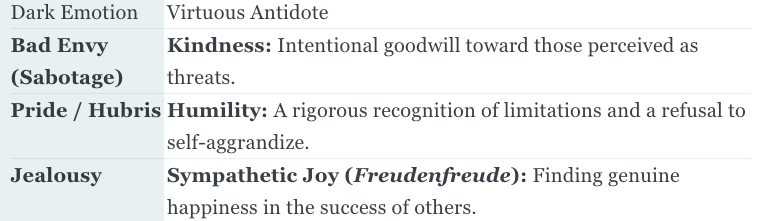
Practicing Sympathetic Joy
To ensure you never become a cutter yourself, you must cultivate freudenfreude. This is the intentional practice of sharing in a peer’s windfall. By training your mind to share in the success of others, you build the psychological immunity necessary to stay tall without succumbing to the envy that fuels the scythe.
Building Long-Term Resilience and Fortitude
Developing Fortitude
Fortitude is a "cardinal virtue"—the mental and emotional strength to face difficulty courageously. It is the essential trait required to reach "Tall Poppydom", especially after a cut down. a second time. True fortitude allows you to encounter danger fearlessly because you understand that setbacks are a prerequisite for gaining strength and greatness.
The "Stone Poppy" Mentality
To survive the "wind" of criticism, you must become a "Stone Poppy." We look to the Matilija Poppy—a flower that grows 6–10 feet tall and is remarkably sturdy—as our symbol.
- Traits of the Stone Poppy:
- Intellectual Exceptionalism: Cultivating a level of skill that makes you indispensable to the world.
- Sturdiness: Developing a "refractory" nature that resists bending to the "lodging" effects of social pressure.
- Refusal to Surrender: Continuing to produce and perform even during periods of "shunning."
Learning from the Hall of Fame
The "Tall Poppy Hall of Fame" is filled with individuals who were cut down before they reached their peak. Katalin Karikó faced demotion and shunning at the University of Pennsylvania, yet her fortitude led to the development of mRNA technology and a Nobel Prize. Jack Ma was rejected by Harvard 10 times and struggled academically before founding Alibaba. The common thread is clear: Fortitude is essential to becoming a Tall Poppy.
Navigating Social and Professional Environments Post-Cut
Identifying the "Wind"
"The tall tree captures all the wind." As a leader, you must accept that criticism is the tax you pay for your height. To protect your organization and yourself, you must identify "cutters" early—those whose low self-esteem leads them to prioritize sabotage over production.
The Zebra Metaphor: Herd Camouflage vs. Sabotage
As Jordan Peterson illustrates through the Zebra Metaphor, stripes do not camouflage a zebra against the grass; they camouflage the zebra against the herd. If a zebra is "marked" or "stands out," the lions strike. Humans possess this same "herd behavior," choosing to stay safely camouflaged in mediocrity. When you stand tall, you lose the protection of the herd. This is why peers choose sabotage—they are terrified that your excellence will expose their own "herd camouflage."
Peer Emulation vs. Sabotage: A Checklist
Assess your professional tribe by asking:
- Do they exhibit good envy (emulation)? Do they align with you to learn and improve themselves?
- Do they exhibit bad envy (sabotage)? Do they use gossip, the "silent treatment," or bureaucratic weaponization to reduce your stature?
- Does the culture reflect Janteloven (no one is allowed to be special) or meritocracy (individual achievement is celebrated)?
Conclusion: The Refractory Nature of Excellence
The poppy's cycle is as persistent as human history itself. From the wheat fields of Herodotus in 430 BC to the modern "cancel culture" of the digital age, the intent remains unchanged: to lop off the heads of those who dare to grow tall.
However, society cannot advance without its TPs. If you have been cut down (private TPS), recognize that your height was the reason you were targeted. For public TPS, you can grow tall again if you arm yourself with fortitude and the virtuous antidote.
Remember: Those who can, do; those who cannot, cut down. Excellence is always easier to spot in person than to define, and true excellence is ultimately refractory to all impediments.

Tall Poppy Syndrome Newsletter
Join the newsletter to receive the latest updates in your inbox.