Former Clippers Kawhi Leonard, Greed, and the Tall Poppy Syndrome.

The greedy bring ruin to their households, but the one who hates bribes will live. Proverbs 15:27 (ESV)
We are exploring how the simple TPS metaphor—the bad envious cutter taking down a public TP—can become complex when its simple psychosocial dynamic is applied to more complex situations (see Carl Sagan, Harvard, and Peer-to-Peer Tall Poppy Syndrome and Ex-CEO Christopher E. Kubasik, Lust, and Public Tall Poppy Syndrome).
TPS is prevalent in American sports but relatively unrecognized (see Is Caitlin Clark a Victim of the Tall Poppy Syndrome?). The same is true of schadenfreude. Sports' daily presence creates plenty of fodder.
The Clippers basketball franchise began in 1970 as the Buffalo Braves, one of three NBA expansion teams. The Braves quickly found a star in TP Bob McAdoo, who won Rookie of the Year and later the NBA MVP. But despite some early success, the franchise struggled financially and eventually moved west.
In 1978, the team became the San Diego Clippers, taking its name from the sailing ships associated with San Diego Bay. Unfortunately, the move did little to change the team's fortunes. The Clippers missed the playoffs throughout their six seasons in San Diego.
In 1984, the Clippers moved north and entered the enormous shadow of the Los Angeles Lakers, who were enjoying the "Showtime" era of Magic Johnson and Kareem Abdul-Jabbar. For decades, the Clippers were essentially the NBA's second-class citizens in their own city. Poor management, losing seasons, and controversial ownership defined much of this period.
A transformation began in the early 2010s. With Blake Griffin, Chris Paul, and DeAndre Jordan, the Clippers became known as "Lob City." They were exciting, nationally relevant, and finally competitive, winning division titles in 2013 and 2014. But they repeatedly fell short in the playoffs.
The organization reached a dramatic turning point in 2014, when owner Donald Sterling was banned for life by the NBA following his racist comments, and Steve Ballmer, the former Microsoft CEO, purchased the team. Ballmer brought enormous financial resources and a radically different level of ambition to the franchise.
The next major chapter came in 2019, when the Clippers acquired Kawhi Leonard and Paul George. The team was suddenly constructed to contend for a championship. In 2021, the Clippers reached the Western Conference Finals for the first time in franchise history, overcoming decades of disappointment—but injuries and playoff setbacks continued to prevent the ultimate breakthrough.
In 2024, the Clippers entered what may be their most symbolic new era. They left Crypto.com Arena, where they had shared a building with the Lakers, and opened their own spectacular Intuit Dome in Inglewood. It represents Ballmer's effort to give the Clippers an independent identity and establish them as a major Los Angeles sports institution in their own right.
They have won three division titles—2013, 2014, and 2024—but have never won an NBA championship or reached the NBA Finals.
The NBA salary-cap system is a cap but not a hard ceiling. It is a complicated set of thresholds that determine how much flexibility a team has to sign, retain, and trade players.
A team starts with a salary cap of about $165 million. If a team has room under the cap, it can sign free agents using that available space. But unlike the NFL, an NBA team can go over the salary cap if it qualifies for one of the league's exceptions.
Bird Rights (exception) allow a team to exceed the salary cap to re-sign its own players. Suppose the Clippers are already $20 million over the cap but one of their stars becomes a free agent. If the player has Bird Rights, the Clippers can potentially re-sign him to a much larger contract rather than first creating $20 million of cap room.
They have other exceptions too arcane for our discussion, such as the Mid-Level Exceptions and the luxury tax. Even more confusing is crossing the first apron ($209.014 million)—crossing the threshold creates additional restrictions on trades and exceptions—and the second apron ($221.686 million)—more severe restrictions. There is also a limit on what an individual player can earn annually.
This is particularly relevant to the Clippers because Steve Ballmer has been willing to spend at levels that would have been virtually unimaginable during the Donald Sterling era. The NBA's current apron system is therefore extremely important to understanding how the Clippers can—and cannot—build their roster.
Steve Ballmer was not one of Microsoft's original founders. He met Bill Gates at Harvard, where the two became friends. Ballmer later entered Stanford's business school but dropped out in 1980 to join Gates at Microsoft. He became the company's first business manager and eventually ran sales, marketing, and operations before becoming CEO in 2000.
Ballmer brought something different to Microsoft. Gates was the technical visionary; Ballmer was the aggressive salesman, organizer, and competitor. His famous intensity became part of Microsoft's culture. He wasn't merely interested in winning—he wanted to dominate. That personality would eventually define his career long after Microsoft.
One of the most revealing episodes in Ballmer's early career comes from Paul Allen's autobiography, Idea Man.
Allen, Microsoft's other co-founder, had become increasingly removed from the company while battling Hodgkin's lymphoma. According to Allen, he overheard Gates and Ballmer discussing Allen's reduced contribution and the possibility of issuing additional stock options that would dilute Allen's ownership.
Allen was furious. He confronted them and saw the discussion as a profound betrayal (see Treachery as Cutter and the Tall Poppy Syndrome)—especially because he was ill and had helped build the company. Ballmer later apologized to Allen, and Gates did too. Most importantly, they did not carry out the proposed dilution.
Ballmer succeeded Gates as Microsoft's CEO in 2000. His challenge was enormous. Microsoft had become one of the world's most powerful companies, but the technology industry was changing rapidly. The PC was no longer the only battlefield.
Microsoft's revenue and profits grew substantially during his tenure, and the company expanded into areas including enterprise software, cloud computing, and gaming. During Ballmer's time as CEO, the company nearly tripled annual revenue and increased net income by more than 200%.
He retired as CEO in 2014.
In 2014, Ballmer bought the Los Angeles Clippers for approximately $2 billion. At the time, it was an astonishing price for an NBA franchise. Ballmer had no intention of being a passive owner.
Kawhi Leonard entered the NBA in 2011 as an unlikely star. He had played his college basketball at San Diego State and was selected 15th overall, but the San Antonio Spurs saw something unusual: enormous hands, exceptional defensive instincts, physical strength, and a work ethic that fit perfectly with the Spurs' culture.
At first, Leonard was asked to do the things young players normally do—defend, rebound, run the floor, and learn. But he developed remarkably quickly. By the 2013–14 season, he had become an essential part of the Spurs' championship team. In the NBA Finals against Miami, Leonard averaged 17.8 points and 6.4 rebounds, while playing superb defense against LeBron James. At only 22, he became the Finals MVP.
The transformation continued. Leonard became one of the league's premier two-way players, winning Defensive Player of the Year in 2015 and 2016. By 2016–17, he was no longer simply a great defender who could score—he was a legitimate superstar, averaging 25.5 points per game and making the All-NBA First Team.
The turning point came in the 2017 Western Conference Finals. Leonard injured his ankle in Game 1 against Golden State, and the injury ultimately ended his playoff run. More importantly, he subsequently developed a serious problem with his right quadriceps.
The injury became the beginning of a much larger crisis. Leonard missed the first 27 games of the 2017–18 season and eventually played only nine games that entire season. He returned in December but continued to experience problems, and the Spurs shut him down indefinitely in January.
Leonard worked with his own medical advisers and spent significant time in New York. The Spurs' medical personnel remained involved, but the relationship between Leonard's camp and the organization deteriorated. When San Antonio entered the playoffs without him, Leonard remained away from the team while continuing his rehabilitation.
Leonard's silence made the situation difficult for the public to understand. Was he genuinely unable to play? Was he being overly cautious? Did he no longer trust the Spurs? Did he want to leave San Antonio? For a franchise built around loyalty, discipline, and organizational trust, this was a dramatic rupture.
On July 18, 2018, San Antonio traded Leonard and Danny Green to the Toronto Raptors. For Leonard, it was a fall from being the centerpiece of one of the NBA's most respected organizations to being viewed by some around the league as a player whose health and commitment had become questions.
Leonard responded in spectacular fashion. He played 60 regular-season games, averaging 26.6 points, then elevated his game during the playoffs. Toronto eventually reached the NBA Finals and defeated Golden State in six games.
Leonard averaged 28.5 points, 9.8 rebounds, and 4.2 assists in the Finals, winning his second Finals MVP. In doing so, he became only the third player in NBA history at that time to win Finals MVP with two different teams.
After winning the championship, Leonard became a free agent. He chose the Los Angeles Clippers, rather than the Lakers, and convinced them to acquire Paul George as his running mate.
In 2019, Kawhi Leonard arrived in Los Angeles as a champion and two-time Finals MVP. He had just led Toronto to its first NBA championship, but instead of staying with the defending champions, Leonard chose his hometown Clippers. His arrival was the biggest moment in Clippers history, and he helped persuade the organization to acquire Paul George, creating one of the NBA's most formidable superstar pairings.
Leonard's first season with the Clippers was spectacular. In 2019–20, he averaged 27.1 points, 7.1 rebounds, and 4.9 assists, earned All-NBA honors, and became the first recipient of the Kobe Bryant All-Star Game MVP Award. In the playoffs, however, the Clippers suffered a stunning collapse against Denver, blowing a 3–1 series lead in the Western Conference semifinals.
The following season provided perhaps the high point of Leonard's Clippers career. He averaged 24.8 points, 6.5 rebounds, and 5.2 assists, then dominated the first two playoff rounds. Against Dallas, he was extraordinary, including a 45-point performance. But in the second round against Utah, Leonard suffered a torn ACL. The Clippers went on to reach the Western Conference Finals—the first in franchise history—but Leonard could not play.
He missed the entire 2021–22 season recovering from the ACL surgery. When he returned in 2022–23, he again demonstrated that he was still a superstar, but injuries increasingly became the defining feature of his Clippers tenure.
The 2023–24 season briefly revived the dream. Leonard played 68 games, his most in a season since 2016–17, and averaged 23.7 points, 6.1 rebounds, and 3.6 assists. But a knee problem returned during the playoffs, limiting him to two games as the Clippers lost to Dallas.
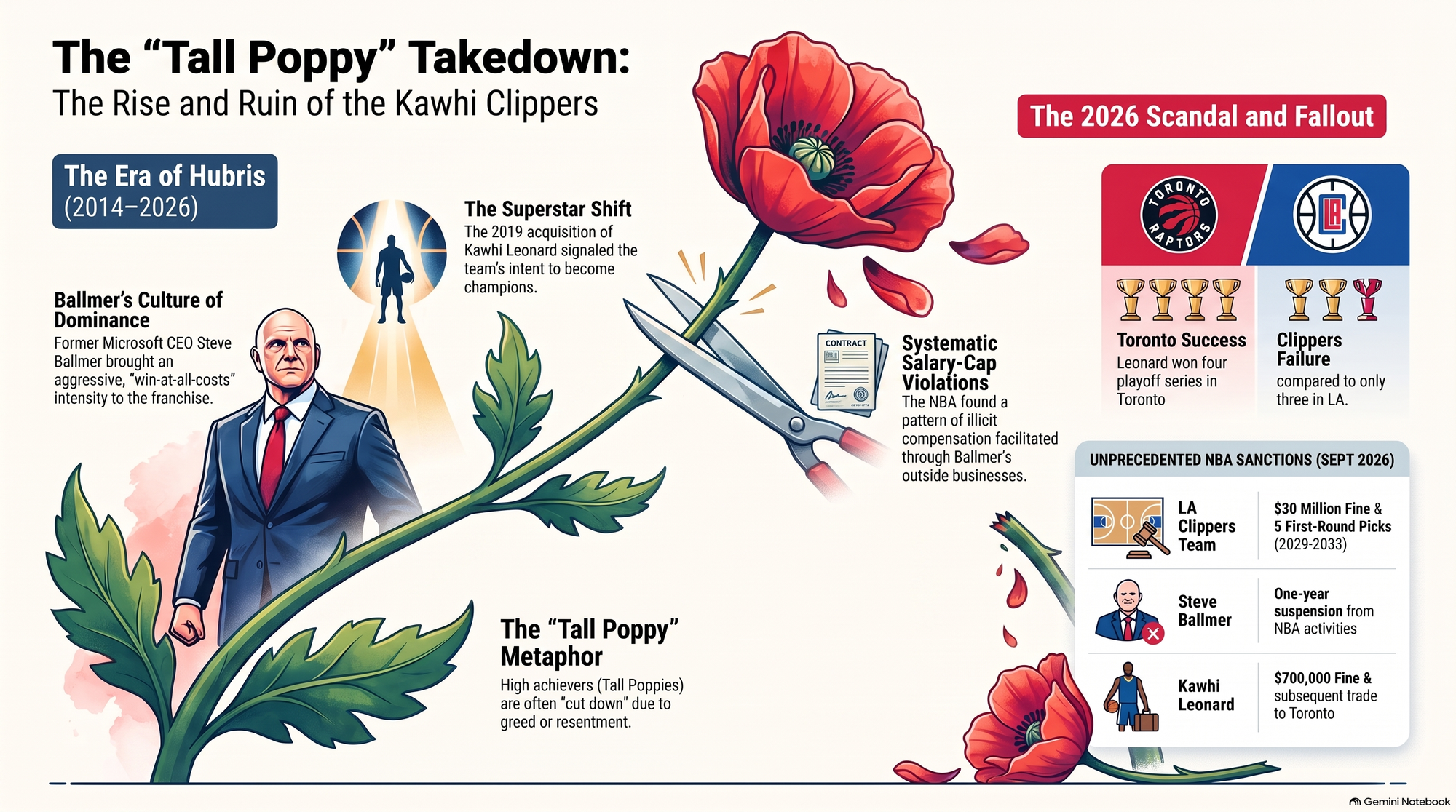
Leonard eventually regained his health and was selected as an All-Star in 2026, but the Clippers never reached the Finals during his tenure. Their only Western Conference Finals appearance came in 2021, when Leonard was injured. In July 2026, after seven seasons with the Clippers, Leonard was traded back to Toronto. Over those seven seasons, he won only three playoff series, compared with four series victories and a championship in his single season with Toronto.
Beginning in 2025, reports emerged concerning Leonard's relationship with Aspiration, a sustainability-focused financial company in which Ballmer had invested. The central question was whether the Clippers had helped arrange outside compensation for Leonard that effectively circumvented NBA salary-cap rules.
The Clippers and Ballmer denied wrongdoing. The NBA then conducted an independent investigation. In September 2026, the league reached a very different conclusion.
The NBA found a pattern of misconduct and multiple significant salary-cap violations. It concluded that the Clippers had helped facilitate endorsement arrangements involving Leonard and companies doing business with the team, and that Ballmer knowingly participated in some of the conduct.
Leonard's uncle and former business manager, Dennis Robertson, was central to the case. He tried to help his nephew, but also himself.
The NBA ultimately concluded that Leonard himself violated the circumvention rules through Robertson's conduct on his behalf. Leonard was also found to have failed to reimburse certain personal expenses the Clippers paid.
The punishment was extraordinary:
- $30 million fine for the Clippers
- Five first-round draft picks forfeited, 2029–2033
- Steve Ballmer suspended for one year
- Clippers business president Gillian Zucker suspended for one year
- Basketball president Lawrence Frank suspended for six months
- Kawhi Leonard fined $700,000
- Dennis Robertson, Leonard's uncle and former business manager, banned from NBA business for five years
- Five years of NBA compliance monitoring
As of September 11, 2026, the U.S. Department of Justice is conducting a separate criminal investigation into the Clippers' dealings with Leonard.
Leonard was cut down by his greed, but his selfish actions led to unintended consequences far beyond his wildest dreams (and pocketbook). Ballmer and his Clippers were greatly diminished (tall poppied), and it will take years to regrow, let alone flourish.
Ballmer and the Clippers raise more complicated questions: when winning becomes the overriding objective, where does relentless competitiveness end and crossing the line begin? Their story is about hubris—ambition, loyalty, money, power, competition, and the price of winning (see Ex -CEO Christopher E. Kubasik, Lust, and Public Tall Poppy Syndrome).
This is a tale of dark emotions in public TPs who acted egregiously and were cut down. Actions have consequences, most unintentionally. Leonard's greed cut down his entire organization, including its owner, who was exposed when the tide went out. There is no schadenfreude, only sadness at human frailty.
Neither party got the memo. The path to tall poppydom is paved with humanity and transcendence, not self-promotion and gluttony—pride and greed (see John Winthrop, Tall Poppies, and the Tall Poppy Syndrome). The road is full of encumbrances, but sustained by virtuosity (see Ben Franklin, Virtues, and the Tall Poppy Syndrome).

And that servant who knew his master's will, but did not get ready or act accordingly to his will, will receive a severe beating. But the one who did not know, and did what deserved a beating, will receive a light beating. Everyone to whom much was given, of him much will be required, and from him to whom they entrusted much, they will demand more. Luke 12:47-48 (ESV)

Tall Poppy Syndrome Newsletter
Join the newsletter to receive the latest updates in your inbox.