Ben Franklin, Virtues, and the Tall Poppy Syndrome.


Mind your business. Benjamin Franklin
The Fugio cent was the first official circulation coin of the United States, minted in 1787 as a copper cent. It’s also called the Franklin cent, and its design is associated with Benjamin Franklin, featuring a sundial with the word “Fugio” (“I flee,” as in “time flies”) and the phrase “Mind Your Business”.
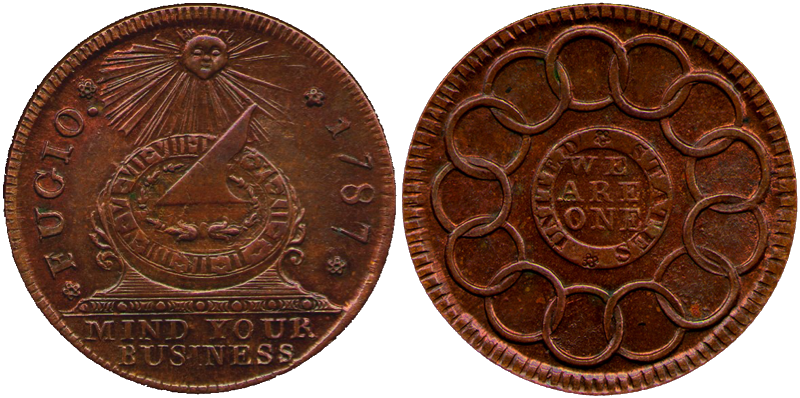
The coin’s reverse shows 13 linked rings with the motto “We Are One,” representing the original 13 states. That design made it both a practical coin and a political symbol for the new nation.
“Mind your business” most likely means “attend to your own affairs” or “focus on your work and responsibilities.” It can also carry a practical money sense: manage your business, finances, and duties wisely.
The phrase sits with the coin’s larger message: “time flies,” so use your time well and do what’s in your proper sphere.
Franklin's Poor Richard’s Almanac centered on practical wisdom, thrift, hard work, and moral self-improvement. It also mixed in humor, proverbs, weather, and astronomical information, and advice about everyday life. Franklin used the almanac not just to entertain, but to teach readers how to live wisely and prosperously. It was a mix of practical advice plus moral instruction.
Themes included: industry and frugality—work hard and save money; practical usefulness—household, farming, health, and seasonal advice; moral conduct— honesty, self-discipline, and virtue; wit and humor—jokes and memorable sayings to make the lessons stick; and social relations—friendship, marriage, and getting along with others.
Franklin’s virtues form a self-improvement program. He tried to train his character through habits, discipline, and daily attention to conduct. The overall idea was that a person could become better by practicing small, repeatable forms of restraint, order, and usefulness.
He treated virtue less as abstract philosophy and more as a practical system for living well. He believed that reputation, productivity, and moral standing were shaped by everyday choices, so he turned virtues into a kind of personal checklist. His belief was that character was built through habits, not just intention.
Some of his virtues include: temperance —avoid excess in food and drink; silence—speak only when it is useful; order—keep things organized and manage time well; resolution—follow through on what you decide to do; frugality—avoid waste; industry—stay busy with useful work; sincerity—avoid deceit and speak honestly; justice: do no harm and fulfill obligations; moderation—avoid extremes; humility— imitate Jesus and Socrates.
TPS is associated with dark emotions, and the majority are found in the seven deadly sins (see The Tall Poppy Syndrome & The Seven Deadly Sins and The Seven Deadly Sins, Christianity, and the Tall Poppy Syndrome). The most common dark emotions in the cutter are envy, anger, and sloth (laziness). Dark emotions noted in the TP are pride, greed, lust, and gluttony, and justify their cut down.
There are six things the Lord hates, seven that are an abomination to him: haughty eyes, a lying tongue, and hands that shed innocent blood, a heart that devises wicked plans, feet that make haste to run to evil, a false witness who breathes out lies, and one who sows discord among brothers. Prov 6: 16-19 (ESV)
The straightforward method, though not as simple as it seems, for thwarting dark emotions and preventing being cut down is to practice their antagonistic virtues. The opposing virtues to the seven deadly sins are: envy - kindness; anger - patience; sloth - diligence; pride - humility; greed - generosity; lust - chastity; and gluttony - temperance.
These virtues help hold onto tall poppydom once acquired. Achieving tall poppydom requires a different set of virtues, which includes the cardinal virtues of courage, wisdom, justice, and temperance, as well as humanity and transcendence.
In 1757, Franklin was sent to England by the Pennsylvania Assembly as a colonial agent to protest against the political influence of the colonies' proprietors —all land in the colonies belonged to the Crown, which held ultimate authority over their management. The British Empire was the largest since the Roman Empire, with London as its center. Franklin's genius was initially celebrated by the populace.
He became a leading spokesman for the American cause, but had to balance this by remaining a loyal British citizen. In the end, he could not serve two kings.
On January 29, 1774, the Privy Council was acting as the king’s advisory body on a colonial petition involving Massachusetts, and Franklin was summoned before it at Whitehall in the Cockpit chamber. In that session, Solicitor General Alexander Wedderburn attacked Franklin over the Hutchinson letters.
The Hutchinson letters were a set of private letters from Massachusetts governor Thomas Hutchinson, lieutenant governor Andrew Oliver, and a few others, written in the late 1760s and made public in 1773. Their main argument was that colonial unrest was serious enough to justify stronger British control, including increased troop levels and a reduction in colonial liberties.
Oliver’s letters proposed restructuring the Massachusetts government so the governor’s council would be appointed by the crown rather than elected by colonial authorities. The letters also urged firmer measures against colonial resistance and treated the political situation as one requiring stronger imperial authority.
Franklin recieved a copy of them and forwarded them to the colonies where they were published. The colonists read them as proof that royal officials were working against local self-government. That outrage helped intensify the conflict between Massachusetts and Britain and is what eventually drew Franklin into the Privy Council controversy.
Franklin's appearance became famous because it publicly humiliated (tall poppied) him and helped harden his break with Britain. It marked a turning point in his political outlook—from a colonial agent to a more committed opponent of British authority.
When Franklin arrived in Philadelphia on May 5, 1775, the American Revolution had begun. The Pennsylvania Assembly unanimously chose Franklin as their delegate to the Second Continental Congress. He was appointed a member of the Committee of Five that drafted the Declaration of Independence. Thomas Jefferson did the heavy lifting while the others added comments and corrections.
On October 26, 1776, Franklin was sent to France as commissioner for the United States. He was now a veteran diplomat and handled his country's affairs with the French nation with great success. He secured the critical military alliance in 1778—finances, troops, and naval assistance. It was with French planning, troops, and ships that Cornwallis was defeated at Yorktown.
The Treaty of Paris was signed in 1783. Did Franklin feel schadenfreude? Probably not! He still had other mountains to move.
Franklin returned home in 1785 as a champion of American independence. He became an abolitionist and freed his two slaves. He later served as president of the Pennsylvania Abolition Society.
Franklin was cut down, as happens to many TPs on the road to tall poppydom. He recognized that the best path to tall poppydom is to lead a virtuous life that emphasizes humanity.
Human rights can only be assured among a virtuous people. The general government... can never be in danger of degenerating into a monarchy, an oligarchy, an aristocracy, or any despotic or oppressive form so long as there is any virtue in the body of the people. George Washington

Tall Poppy Syndrome Newsletter
Join the newsletter to receive the latest updates in your inbox.