The Resilient Poppy

Life doesn’t get easier or more forgiving, we get stronger and more resilient.
~ Steve Maraboli
Resilience is the ability to meet pain without letting it wholly define or destroy you—to adapt, recover, and remain connected to your values, relationships, and capacity for meaning.
We often speak of resilience as though it means being unbreakable—a wall that nothing can penetrate, a person who keeps going without flinching, needing, or feeling.
But that is not resilience. That is armor.
Real resilience is not a wall that nothing can penetrate. It is the capacity to remain flexible, to absorb impact, recover, and stay connected to what matters.
That distinction matters when we consider TPS—the impulse to criticize, resent, diminish, or “cut down” people who stand out. The person who succeeds, creates, speaks honestly, changes, or simply allows themselves to be visible may become a target—not always because they have done something wrong, but because their growth unsettles someone else.
A TP may be cut down. But a resilient TP grows stronger. My book, The Tall Poppy Syndrome - The Joy of Cutting Others Down, had a chapter titled "Tall Poppy Hall of Fame." All the TPs were cut down, often multiple times, and grew taller before entering tall poppydom. Obstacles reenergized their mission, lifting them to new heights. En garde!
More Than Toughness
Being resilient does not mean criticism does not hurt. It does not mean that rejection slides off us, that betrayal leaves no mark, or that loss does not bring grief. In fact, Dante believes betrayal leaves one of the biggest marks on one's soul (see Dante, The Divine Comedy, and the Tall Poppy Syndrome).
It means we can meet pain without letting it wholly define or destroy us. We adapt, recover, and remain connected to our values, relationships, and capacity for meaning.
Sometimes that looks strong from the outside—returning to work after failure, speaking up after being silenced, beginning again after disappointment. But often it looks quieter. It may mean resting. Asking for help. Mourning what happened. Changing direction. Releasing the need to be understood by people committed to misunderstanding us.
A TP does not prove its strength by never bending in the wind. Its strength is in remaining rooted enough to bend, endure the storm, and grow again. Rarely, lodging occurs — the permanent bending of the stems of grain crops such as wheat and barley from wind, which makes harvesting difficult and reduces yield—and the fallen poppy never reaches its former height (see Jordan Peterson, Zebras, & The Tall Poppy Syndrome - Part 2).
Let me be like wheat in wind, bending just so. Gary Soto
When Love Makes Us Vulnerable
Love complicates resilience because love opens us.
When we love a person, a community, a calling, or a version of ourselves that we are trying to become, we give something the power to affect us. We can be disappointed. We can be rejected. We can lose what we thought would remain.
That vulnerability can feel like weakness—especially for someone who has learned to survive through self-protection. Hardness can seem safer. If nothing gets in, perhaps nothing can hurt us.
Yet armor has a cost. It may protect us from injury, but it can also prevent comfort, intimacy, joy, and support from reaching us.
Love is not the opposite of resilience; it is what makes resilience costly, human, and worth having.
It gives us something to lose, yes. But it also gives us something to return to—the people who steady us, the work that calls us forward, the values that remain true even after we have been wounded.
The Cut-Down Poppy
TPS often teaches a painful lesson: Do not stand out. Do not become too visible. Do not shine too brightly. Do not risk making others uncomfortable.
After enough cutting, a person may start doing the cutters' work. They may shrink their ambitions, downplay their gifts, withhold their ideas, or treat their own desire to grow as arrogance—lodging like wheat.
But being cut down is not proof that one deserved to be smaller.
Sometimes criticism is useful and necessary; it can teach us accountability, humility, and care for others. But criticism meant to diminish rather than clarify is different. Its goal is not growth. Its goal is reduction.
Resilience means learning to tell the difference.
It means listening when there is something to learn, making repairs when we have caused harm, and refusing to confuse another person’s insecurity with an accurate measure of our worth.
Growing Back Without Hardening One's Heart
The goal is not simply to grow back taller in order to prove the cutters wrong. That can leave us trapped in their judgment, still measuring our life against their disapproval.
The deeper response is to grow because growth is our nature.
A resilient TP returns to its roots—internal virtues, not external validation. This includes self-respect instead of shame; trusted relationships instead of isolation; meaningful work instead of approval-seeking; healthy boundaries instead of bitterness; and love instead of retaliation.
Love does not ask us to tolerate mistreatment or remain exposed to those who repeatedly cut us down. Loving ourselves may mean stepping away, becoming more discerning, or finding a different field in which to grow.
Staying Upright
Perhaps resilience is the ability to absorb pain and adapt—to stay upright, in whatever form uprightness must take, no matter what happens to us.
Not untouched. Not unchanged. Not endlessly strong.
But still capable of returning to what matters.
The resilient TP may lose a blossom. It may bend low. It may need time, rain, sunlight, and good soil before it rises again.
But its life is not defined by the cut.
Its life is defined by the roots that remain, the love that nourishes it, and its continuing reach toward the light.
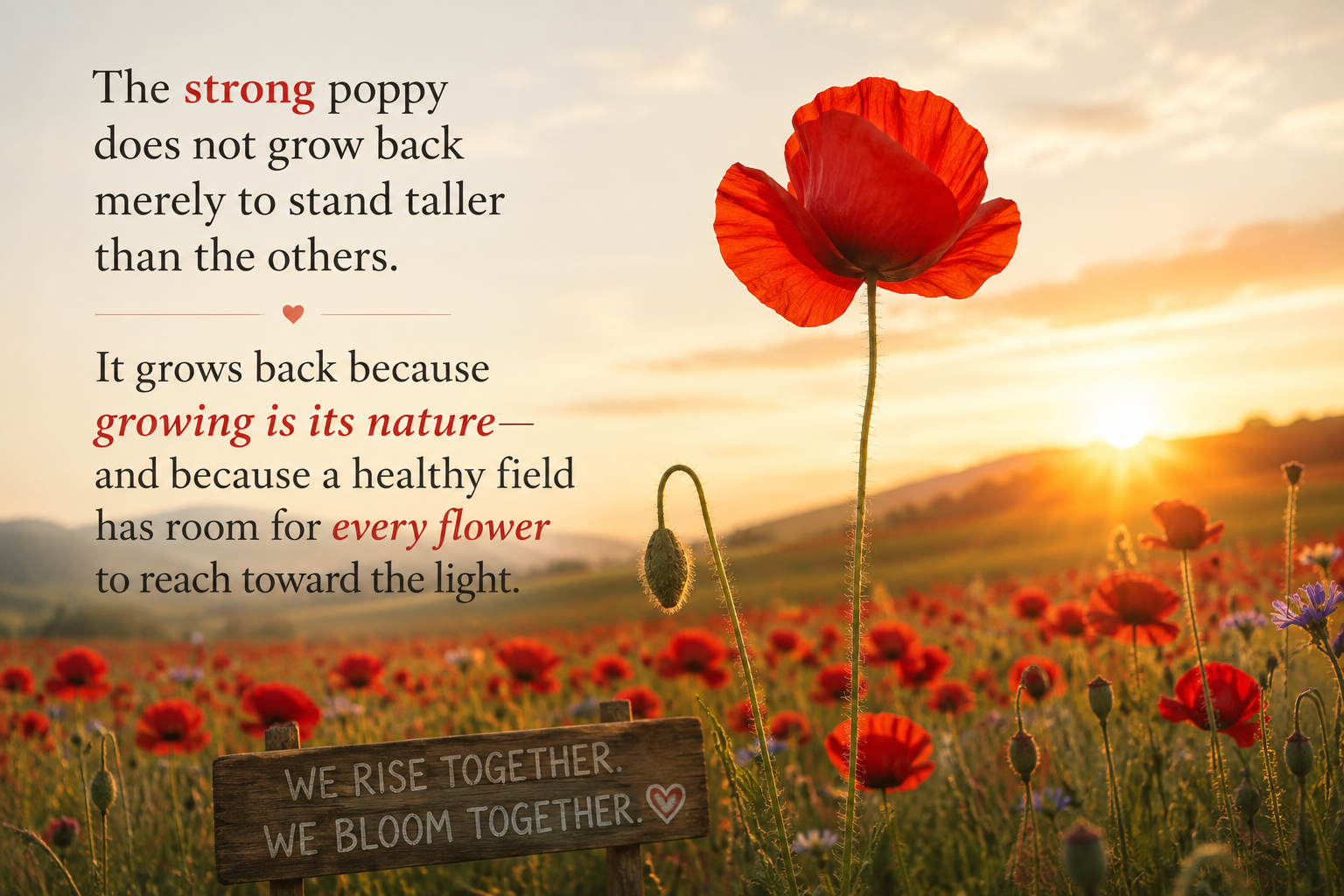
The TP does not grow back merely to stand taller than the others. It grows back because growing is its nature—and because a healthy field has room for every flower to reach toward the light (see John Winthrop, Tall Poppies and the Bible).

Tall Poppy Syndrome Newsletter
Join the newsletter to receive the latest updates in your inbox.