Anarchy, Socialism, and the Tall Poppy Syndrome.

But I say to you that everyone who is angry with his brother will be liable to judgment; whoever insults his brother will be liable to council; and whoever says, 'You fool!' will be liable to the hell of fire. So if you are offering your gift at the altar and there remember that your brother has something against you, leave your gift before the altar and go. First be reconciled to your brother, and then come and offer your gift.
Matt 5:22-24
We have previously explored the intricacies of TPS and social movements (see Social Movements and the Tall Poppy Syndrome). Anger and injustice are commonly the dark emotions driving the movement. There is often a tendency to target opponents on both sides of the conflict, resulting in unintended collateral damage and consequences. We seem again to be headed down a well-trodden path.
Anarchism in the late 19th and early 20th centuries was not a single organism but a broad political philosophy that rejected coercive government and, in some versions, all forms of hierarchy. It was vibrant in Europe and the United States through labor, immigrant radical circles, pamphlets, newspapers, and debates over “direct action,” including the controversial idea of propaganda of the deed — dramatic acts intended to inspire revolt or expose state power.
In the U.S., anarchism overlapped with labor unrest, anti-capitalist politics, and immigrant communities, and it was often treated by authorities and the press as a dangerous extremist threat rather than as a coherent social movement.
Leon Czolgosz emerged from that world of discontent, though he was not a major leader or theorist. He was a laborer who became radicalized by inequality and by radical reading. By 1901, he had come into contact with anarchist circles and was influenced by the wider culture of militant anti-state politics. On September 6, 1901, he went to the Pan-American Exposition in Buffalo, where President McKinley was greeting the public in a receiving line at the Temple of Music. Czolgosz concealed a revolver with a handkerchief and shot (tall poppied) McKinley twice at close range.
McKinley did not die immediately. He initially seemed to be recovering, but the wound became infected because of poor surgical technique, and gangrene set in. He died on September 14, 1901, eight days after the shooting. Czolgosz was quickly arrested, confessed to acting for the anarchist cause, and was tried in a brief proceeding that ended in conviction and execution later that year.
The assassination shocked the country and intensified public fear of anarchism, helping to associate the movement in many Americans’ minds with political violence even though most anarchists did not endorse murder.
The socialist movement and anarchism overlapped, but they were not the same thing. They shared a critique of capitalism, support for labor struggle, and faith in working-class emancipation, yet socialism usually aimed to use political parties, unions, and government power, while anarchism was more skeptical of the state itself.
Socialists generally believed organized politics and mass movements could win public ownership or democratic control of industry, while anarchists tended to reject centralized authority as a source of domination. That difference mattered in strategy: socialists built parties and electoral campaigns, while anarchists were more associated with direct action.
In late 19th- and early 20th-century radical politics, anarchists and socialists often circulated in the same labor and immigrant milieus, read some of the same papers, and fought for better wages, shorter hours, and broader worker power.
Eugene V. Debs — the father of American sociology, a social scientist and activist (Is It Time to ‘Liquidate’ the Study of Sociology?) — emerged from the labor movement and became the most prominent American socialist of his era, arguing for a worker-centered transformation of society.
Debs was not an anarchist, but he did share with them a deep hostility to exploitation and a strong suspicion of corporate power. He became a socialist in 1897 and later ran for president five times as the Socialist Party’s candidate. In practice, Debs represented the electoral and organizational wing of radical labor politics, while anarchists represented the anti-state wing.
The overlap became politically important after McKinley’s assassination, because authorities and much of the press tended to blur anarchists, socialists, and labor radicals together as if they were part of one threat. That was a simplification: the movements intersected in people, language, and grievances, but they were distinct traditions with different theories of change.
Eugene V. Debs’s imprisonment (tall poppied) is one of the most famous free-speech cases in U.S. history. He was jailed not for violence, but for a World War I antiwar speech that the government said undermined the war effort.
On June 16, 1918, Debs spoke at a Socialist Party gathering in Nimisilla Park, Canton, Ohio, where he had come to visit three jailed socialists convicted under the Espionage Act. In his speech, he condemned the war, praised international socialism and the Russian Revolution, and argued that wars served the “master class” while workers did the fighting.
The prosecution focused on a few lines — especially the idea that the “master class has always declared the wars, the subject class has always fought them” — as evidence that he was trying to obstruct recruiting and encourage disloyalty in the military.
Debs was indicted on June 29, 1918, under the Espionage Act of 1917, which made it a federal crime to willfully interfere with the war effort or military recruitment. His federal trial began in Cleveland in early September 1918.
Debs largely defended himself, speaking directly to the jury about his principles and the right to criticize the war. The jury found him guilty on three counts: attempting to cause insubordination and disloyalty in the armed forces, obstructing recruitment, and using language to encourage resistance to the U.S. war program.
In September 1918, Judge David C. Westenhaver sentenced Debs to 10 years in federal prison and stripped him of voting rights. Debs appealed, arguing that his speech was protected by the First Amendment.
In Debs v. United States (1919), a unanimous Supreme Court upheld his conviction. Justice Oliver Wendell Holmes Jr. wrote that, even though Debs had not explicitly called for draft resistance, the jury could infer from the “intent” and “tendency” of his words that he was trying to obstruct recruitment during wartime. Legal scholars now treat this as a major low point in free-speech protection.
Debs was sent to the federal penitentiary in Atlanta, where conditions were harsh, and his health deteriorated. While in prison, he ran for president again in 1920 on the Socialist Party ticket and received nearly a million votes, campaigning from his cell through letters and statements.
President Woodrow Wilson refused repeated requests to pardon him, even as Debs grew visibly ill and public pressure mounted. After Wilson left office, President Warren G. Harding commuted Debs’s sentence to time served in December 1921, and Debs was released on Christmas Day.
He died in 1926, but his imprisonment became a lasting symbol of wartime repression of dissent and of the clash between socialist politics and the national-security state.
The Palmer Raids were a series of federal and local police operations in 1919–1920 that targeted suspected anarchists, communists, and radical leftists, especially foreign-born activists, at the height of the post–World War I “Red Scare” (see The Tall Poppy Syndrome - The Joy of Cutting Others Down).
After a wave of strikes, race riots, and anarchist bombings in 1919—including one that partially destroyed Attorney General A. Mitchell Palmer’s own home—the Justice Department, under Palmer and a young J. Edgar Hoover, decided to treat radicalism as a national security threat. Hoover’s group compiled lists of radicals and prepared for mass arrests and deportations.
On November 7, 1919, Federal agents and local police raided the headquarters of the Union of Russian Workers in New York and other cities, arresting hundreds of suspected radicals. On January 2, 1920, thousands of people were arrested—estimates range from about 3,000 to over 10,000—many without proper warrants and often simply for being foreign-born or having a radical accent.
Among those targeted were members of the Communist Party, the Communist Labor Party, anarchist groups, and the Industrial Workers of the World (IWW).
The raids were marked by widespread civil-liberties violations. Arrests far exceeded the number of warrants obtained. Many detainees were held without timely access to counsel, without clear charges, and in overcrowded, harsh conditions. There were reports of coerced confessions, forged signatures, and physical abuse. Massachusetts District Court Judge George Anderson denounced the methods, calling the government-led roundup “a mob,” and threw out many cases.
Palmer framed the operation as a patriotic defense against a supposed communist conspiracy, but the Department of Labor’s acting secretary, Louis Post, canceled more than 70% of the deportation warrants he reviewed, citing legal deficiencies.
The immediate results were 500–560 foreign nationals deported, including prominent anarchists Emma Goldman and Alexander Berkman, who were sent to Russia on the so‑called “Soviet Ark” in December 1919. Thousands more were arrested, but many charges were dropped or reversed as courts and officials recoiled from the tactics.
Politically and legally, the outcome was a backlash. When Palmer’s dire prediction of a massive May Day 1920 revolution failed to materialize, his credibility collapsed, and public opinion turned against the raids. The raids helped catalyze the formation of the American Civil Liberties Union (ACLU) in 1920, as lawyers and intellectuals organized to defend civil liberties against such government overreach.
In the longer term, the Palmer Raids became a standard example in U.S. history of how fear of radicalism can lead to mass arrests, due-process violations, and the targeting of immigrants, but also how such repression can spark organized civil-liberties resistance.
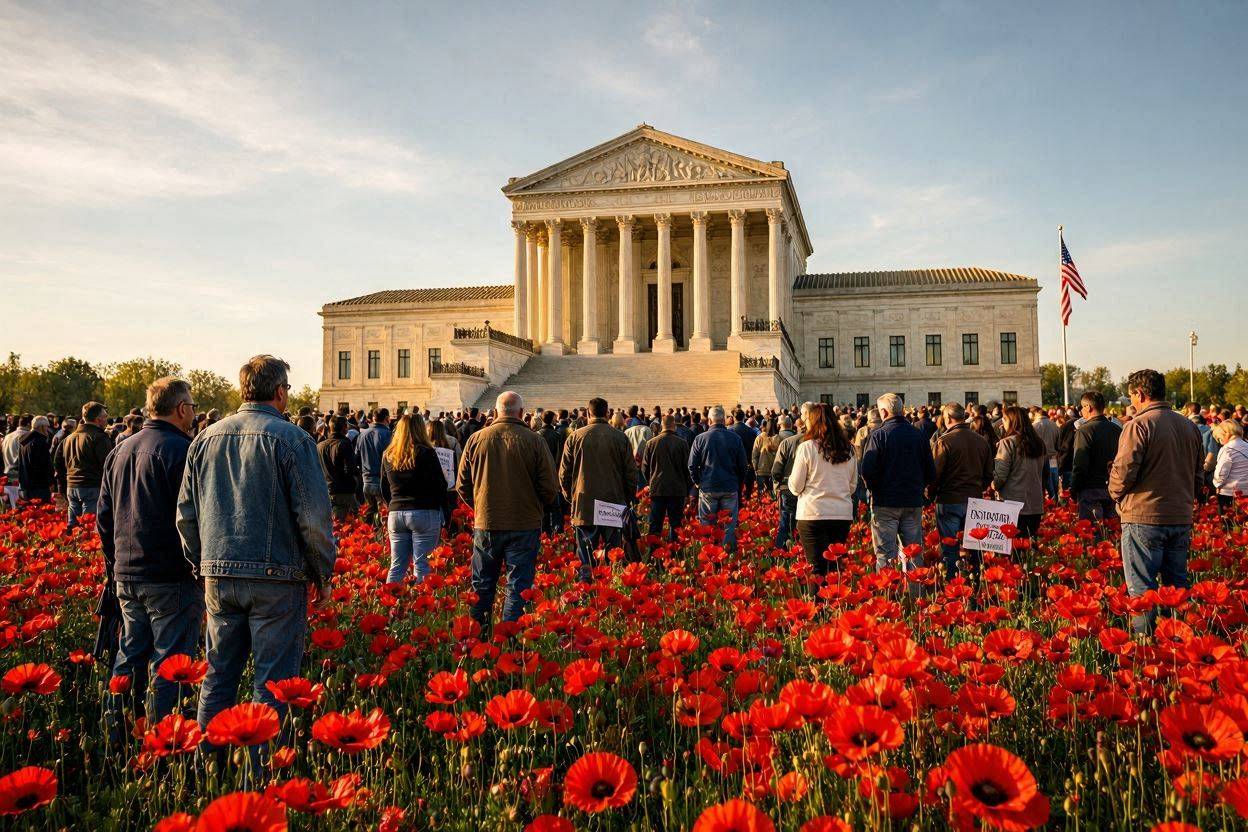
Political Violence (terrorism). Recently, a couple of members of the Supreme Court were in Congress requesting funds to increase security for their safety. It seemed ironic that some of the same people who are part of the problem are offering more of their unearned money as part of the solution. The government rarely has the resolve to identify and fix problems — the public often knows the problem and its causes and wants change — but instead does what our government almost always does: throw more money at it and increase taxes without fixing it (see Bad Envy, Inequality, and the Tall Poppy Syndrome).
More security will provide safety but not solve this problem. The tall poppy solution is for leaders to let go of their anger, reconcile with their opponents, compromise, and become part of the solution and a beacon of light for all their opponents and constituents. John Winthrop, Tall Poppies, and the Bible).
Do not throw out the baby with the bathwater. Thomas Murner

Tall Poppy Syndrome Newsletter
Join the newsletter to receive the latest updates in your inbox.