Bad Envy, Inequality, and the Tall Poppy Syndrome

And there we saw Nephilim (the sons of Anak, who come from the Nephilim), and we seemed ourselves like grasshoppers, and so we seemed to them. Num 13:33 (ESV)
Most people innately value fairness and equality. This has been documented in the animal kingdom as well. Some governments champion egalitarian societies, such as those in Australia and the Scandinavian countries, to ensure equality.
Our founders wanted to establish a new country of many freedoms, especially individual liberty. The individual, not the government or social class, would be the essential unit. "Government creep" on our liberties is occurring with the assistance of some leaders and citizens, but has not yet reached the level seen in the 1890-1940 period.
Taxes targeted solely at the wealthy can be seen as examples of TPS (see Millionaires, Taxes, and the Tall Poppy Syndrome and Are England's Millionaires Being Tall Poppied?). Taxing the rich seems to be popping up in America and elsewhere as a means of narrowing the widening gap between the upper and lower financial classes. Some argue that the rich became so on the backs of the lower class.
Frans de Waal (1948–2024) was a Dutch-American primatologist and ethologist, widely regarded as one of the most influential scientists in the study of animal behavior, particularly of great apes.
He spent much of his career at Emory University in Atlanta, where he was a professor of psychology and director of the Living Links Center at the Yerkes National Primate Research Center.
De Waal was a pioneer in arguing that emotions such as empathy, compassion, and a sense of fairness are not uniquely human but have deep evolutionary roots, observable in chimpanzees, bonobos, and other primates.
His early landmark research on chimpanzees at Arnhem Zoo documented reconciliation behavior after fights — showing that animals actively make peace, a concept that was novel at the time.
He brought widespread attention to bonobos as a contrast to the more aggressive chimpanzee, highlighting their use of social bonding and sexuality to resolve conflict.
De Waal fundamentally shifted scientific and public thinking away from the idea that nature is purely "red in tooth and claw," making the case that cooperation, altruism, and social intelligence are central to primate — and human — evolution. He passed away in March 2024.
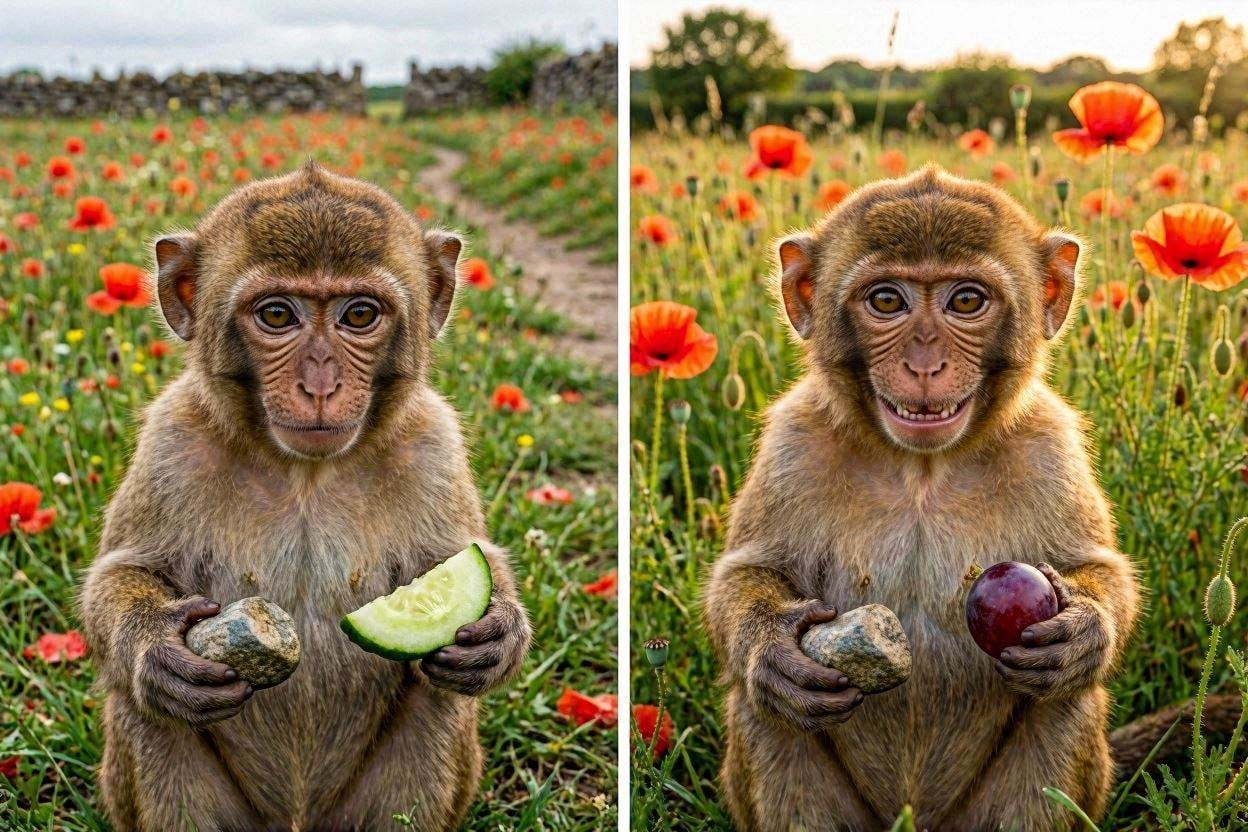
In 2003, Frans de Waal and his colleague Sarah Brosnan designed a now-famous experiment with capuchin monkeys. Two monkeys were placed in adjacent enclosures where they could see each other clearly. They were trained to exchange a token — a small rock — with a researcher in return for a food reward.
When both monkeys were given a cucumber for completing the task, de Waal noted they were "perfectly willing to do this 25 times in a row." A cucumber slice was not exactly gourmet, but it was food, and the monkeys were happy enough. There was no complaint, no drama — just two cooperative little primates doing their jobs and collecting their pay.
Then the experiment shifted. One monkey continued to receive a cucumber slice for handing over her rock — until the monkey beside her was given a much more desirable reward: a grape, for doing the exact same job. Grapes are sweet, juicy, and far more "coveted" in the capuchin world. The first monkey noticed immediately.
The first monkey, now seemingly furious, pounded the table in protest and rattled the walls of her cage. She flung the cucumber slice back at the researcher, refusing to accept what moments ago had seemed perfectly adequate. The injustice of receiving lesser pay for equal work was not going to be tolerated.
During the experiments, monkeys, when rewarded equitably, rejected the cucumber just 5 percent of the time. But if their partner received a grape, they refused their lower pay at a rate of 50 percent. And when partners were given a grape "for free" — without even having to hand over a pebble — rejections soared even higher.
When de Waal's colleague ran the same experiment with chimpanzees, the results were even more striking. It was common for the chimp who received the grape to refuse the unfair treatment until the other chimp was also given a grape — chimps rejecting their own privilege.
The study drew several landmark conclusions. Fairness is not uniquely human. De Waal argued that "instead of fairness and justice being intellectual products arrived at through reason, they are embedded in basic emotions, some of which are found in other primates," possibly through a shared evolutionary history.
Morality has ancient roots. De Waal concluded that the monkeys' rejection of unfairness shows that morality doesn't come from a learned belief system — our desire for fairness is not a post-Enlightenment concept, but something natural and ancient.
Our Founding Fathers got it right (see John Wilkes, Good Envy, and the Tall Poppy Syndrome) — "We hold these truths to be self-evident, that all men are created equal, that they are endowed by their Creator with certain unalienable Rights, that among these are Life, Liberty and the pursuit of Happiness."
"the last best hope of earth" Abraham Lincoln
I grew up in a small rural town in Iowa. Our society was egalitarian. No one was wealthy, including the farmers who were "cash poor, land rich." But farming was unpredictable—too much rain, not enough rain, early frost, late planting, and grasshoppers. Much of the land was mortgaged to raise cash during bad years.
Now, some grasshoppers are complaining about income inequality, and some of their grievances are legitimate. The problem is not the rich but the governance opting for the simple solution. Increasing their coffers will not change the structural problems causing the discrepancy — high interest rates, high housing costs, high state and federal taxes, high college costs, etc.
Every person in America still has the freedom and opportunity to succeed and achieve a better life. I am for better governance and less of the "cash poor, envy rich."
If I do my job right, the value to society and civilization from my for-profit companies will be much, much larger than the good that I do with my charitable giving. Jeff Bezos

Tall Poppy Syndrome Newsletter
Join the newsletter to receive the latest updates in your inbox.