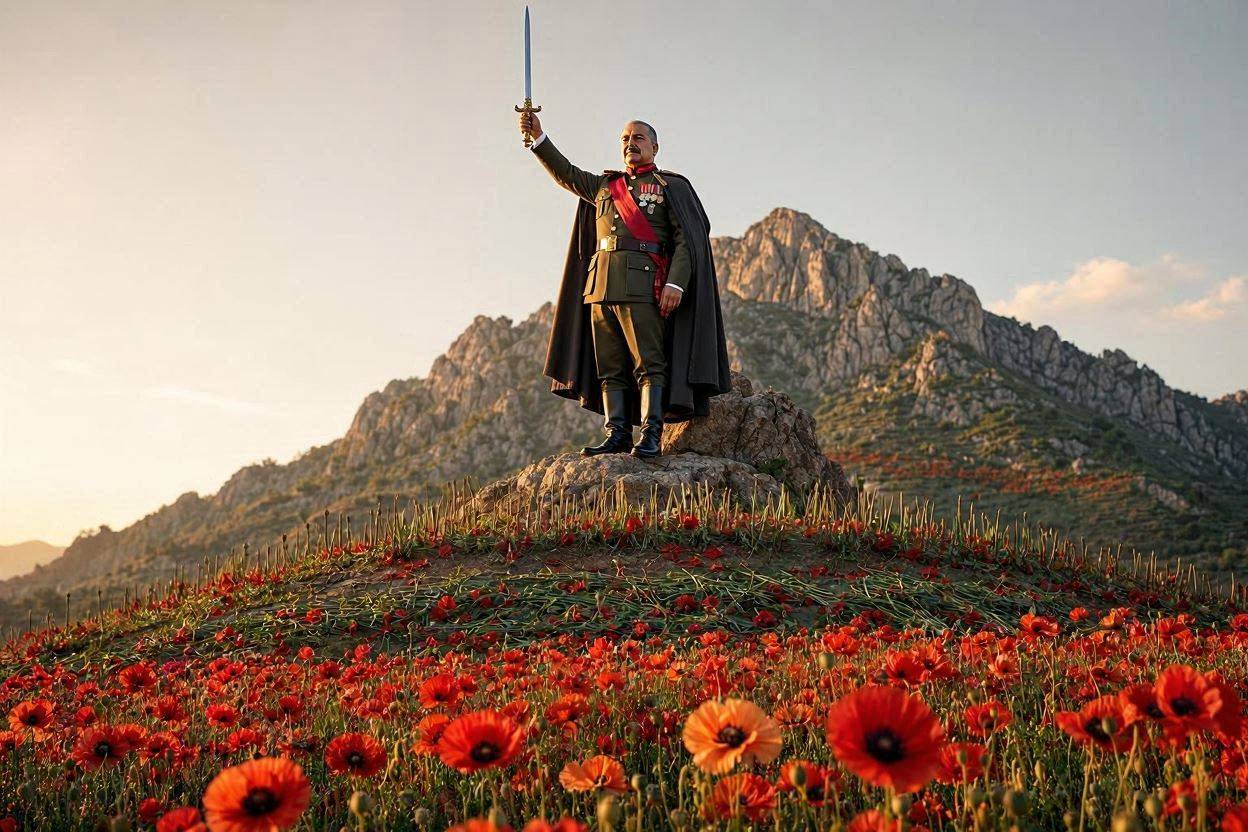
Nicaraguan President Daniel Ortega and the Tall Poppy Syndrome.

The difference between a democracy and a dictatorship is that in a democracy you vote first and take orders later; in a dictatorship you don't have to waste your time voting.
~ Charles Bukowski
Dictatorships are the epitome of TPS. The original descriptions of TPS were Greco-Roman leaders who cut down opposing leaders, both literally and figuratively. Although we have discussed dictatorships — Self-Righteousness and Hypocrisy as Cutters in the Tall Poppy Syndrome and Tall Poppy Syndrome: A Radio Interview with Brian Reynolds — we have never featured one.
Augusto César Sandino, the guerrilla leader who fought U.S. military occupation of Nicaragua (1927–1933), was assassinated (tall poppied) on the orders of General Anastasio Somoza García — later President (1937) and assassinated (1956). Sandino's legacy as a nationalist martyr would inspire the Sandinista National Liberation Front (FSLN) three decades later.
Carlos Fonseca Amador, Tomás Borge Martínez, and Silvio Mayorga founded the Sandinista National Liberation Front (FSLN) in 1961, initiating the Nicaraguan Revolution (1961-1990). Inspired by the Cuban Revolution, the FSLN was committed to socialism and the overthrow of the Somoza dynasty that had ruled Nicaragua since 1937.
On December 13, 1973, a devastating 6.2 magnitude earthquake destroyed Managua, killing an estimated 10,000 people. Anastasio Somoza Debayle (President) and the National Guard siphoned off international relief aid, exposing the regime's corruption and dramatically eroding its legitimacy. The crisis radicalized broad sectors of Nicaraguan society.
Carlos Fonseca Amador, the principal ideological architect of the FSLN, was killed (tall poppied) in combat with the Nicaraguan National Guard in the mountains of Zinica on November 7, 1976. His death transformed him into a martyr and rallying symbol for the Sandinista movement, even as the FSLN fractured into three rival tendencies.
On January 10, 1978, Pedro Joaquín Chamorro, the prominent opposition newspaper editor of La Prensa, was assassinated (tall poppied)—widely believed on Somoza's orders. His death ignited a general strike and mass protests, uniting moderates, business leaders, and the FSLN in a broad coalition against the Somoza regime.
A FSLN commando unit led by Édén Pastora ('Comandante Cero') seized the National Palace in Managua, taking some 1,500 hostages, including congressmen, on August 22, 1978. The audacious raid forced Somoza to release political prisoners, pay ransom, and guarantee safe passage—humiliating the regime and electrifying the revolutionary movement.
On July 19, 1979, after months of fighting across Nicaraguan cities, the FSLN's Final Offensive toppled Anastasio Somoza Debayle, ending 42 years of dynastic dictatorship. Somoza fled to Miami and then Paraguay, where he was assassinated (tall poppied) in 1980. A five-member Governing Junta of National Reconstruction took power, including Daniel Ortega, marking the first socialist revolution to succeed in Latin America since Cuba in 1959.
The new Sandinista government confiscated the Somoza family's vast landholdings and nationalized major industries, redistributing property through agrarian reform. While adopting socialist policies, the FSLN did not fully implement Soviet-style central planning, tolerating small and medium private farms and businesses. Over time, however, the resignations of non-Marxist junta members pushed the government progressively leftward.
In March, 1981, Daniel Ortega was elevated to coordinator of the Governing Junta by the FSLN National Directorate. He was chosen over more dominant commanders like Tomás Borge, Humberto Ortega, and Henry Ruiz precisely because he appeared less threatening—a calculation that would prove defining for the movement's future.
President Ronald Reagan (November 1981) authorized the CIA to organize, arm, and train a counterrevolutionary force—the Contras—drawn from former National Guard members and anti-Sandinista exiles. Reagan viewed the Sandinista government as a Soviet beachhead in Central America and a threat of communist spread to El Salvador and beyond. The Contras established major bases in Honduras.
In 1982, U.S.-backed Contra forces launched attacks from bases in Honduras into northern Nicaragua. The Sandinista government declared a state of emergency, suspending civil liberties and censoring the press. The Contra insurgency would escalate into a brutal civil war over the next seven years, with the FDN (Democratic Force of Nicaragua) operating from Honduras and ARDE (Revolutionary Democratic Alliance) from Costa Rica.
On November 4, 1984, Daniel Ortega was elected president in a vote that the Sandinistas won decisively. The election was boycotted by major opposition parties and widely criticized by the U.S. government, which refused to recognize its legitimacy. The vote nonetheless consolidated FSLN formal political control.
The FSLN government and the Contras signed a ceasefire (1988) at Sapoá, on the Costa Rican border, under the framework of the Esquipulas Accords. The agreement included provisions for Contra demobilization and political reintegration. Though fragile, it marked the de facto end of the Contra War's major military phase.
On February 25, 1990, Violeta Barrios de Chamorro, widow of assassinated editor Pedro Joaquín Chamorro, defeated Daniel Ortega in the presidential election as head of the 14-party National Opposition Union (UNO). Ortega conceded peacefully, making Nicaragua one of the few revolutionary governments to lose power at the ballot box. The war-weary Nicaraguan electorate had voted for peace and economic recovery.
Daniel Ortega was sworn in for his second presidency on January 10, 2007, after winning the November 2006 election with 38% of the vote. He had lost three consecutive presidential elections (1990, 1996, 2001) before engineering his return through a political pact with Arnoldo Alemán of the Constitutional Liberal Party, which lowered the winning threshold from 45% to 35%.
Ortega entered office rebranded as a "Christian socialist" promising "peace and reconciliation." He initially maintained the Central American Free Trade Agreement (CAFTA-DR) with the United States, upheld market reforms, and launched programs to address hunger and illiteracy. A critical lifeline came from Venezuelan President Hugo Chávez's PetroCaribe initiative, which supplied oil at discounted prices; Nicaragua resold it at market rates and poured the profits into social programs. Poverty fell from roughly 42% to 30% between 2009 and 2014, GDP growth hit 6% in 2011, and unemployment dropped to about 7%.
After his first year, Ortega began restricting press access and consolidating power. The Nicaraguan Supreme Court — stacked with FSLN loyalists — struck down the constitutional ban on consecutive re-election, clearing his path to run again (2009). He was re-elected in 2011 with roughly 60% of the vote amid allegations of fraud. The FSLN won 62 of 90 National Assembly seats — a "supermajority".
The supermajority pushed through constitutional reforms that removed presidential term limits entirely and granted the president decree powers. The judiciary, electoral council, military, and police were brought under FSLN control. He was re-elected in 2016 with over 72% in an election boycotted by the opposition and conducted without international observers.
In April 2018, mass protests erupted after Ortega cut social security benefits. The government responded with lethal force — human rights organizations documented over 300 deaths. The crackdown marked the point where the regime dropped any pretense of democratic governance. Opposition parties were banned, dissidents imprisoned, and civil society organizations shuttered.
Ahead of the November 2021 election, Ortega jailed every credible opposition candidate — including Cristiana Chamorro, daughter of Violeta Chamorro who had defeated him in 1990. Only minor, unknown candidates were permitted to run. The result, returning Ortega for a fourth consecutive term, was dismissed by the international community as a sham; President Biden called it "a pantomime election that was neither free nor fair".
In November 2025, the FSLN-dominated National Assembly approved a constitutional amendment that extended the presidential term from five to six years; elevated Ortega's wife, Rosario Murillo, to the official position of "co-president"; and eliminated remaining institutional checks on executive power.
On July 19, 2026 — the 47th anniversary of the Sandinista Revolution — Ortega declared publicly that there would be no more elections in Nicaragua, stating that the opposition would use them to "seize power." The Nicaraguan legislature is currently debating formal legislation to bar opposition parties from participating in any future vote. The opposition has described Nicaragua as "the North Korea of Latin America".
Ortega has now been in power longer than any member of the Somoza dynasty he helped overthrow. The FSLN, once a revolutionary movement that overthrew a dictatorship, has itself become the governing apparatus of an authoritarian regime under Ortega and co-president Murillo (see John Winthrop, Tall Poppies, and the Bible).
One thing is certain. TPS will continue to thrive under the present form of governance. Will they become a democracy? Not yet!
Tall Poppy Syndrome Newsletter
Join the newsletter to receive the latest updates in your inbox.