Social Media Spawns the Tall Poppy Syndrome.

The world is not driven by greed, it's driven by envy. Charlie Munger
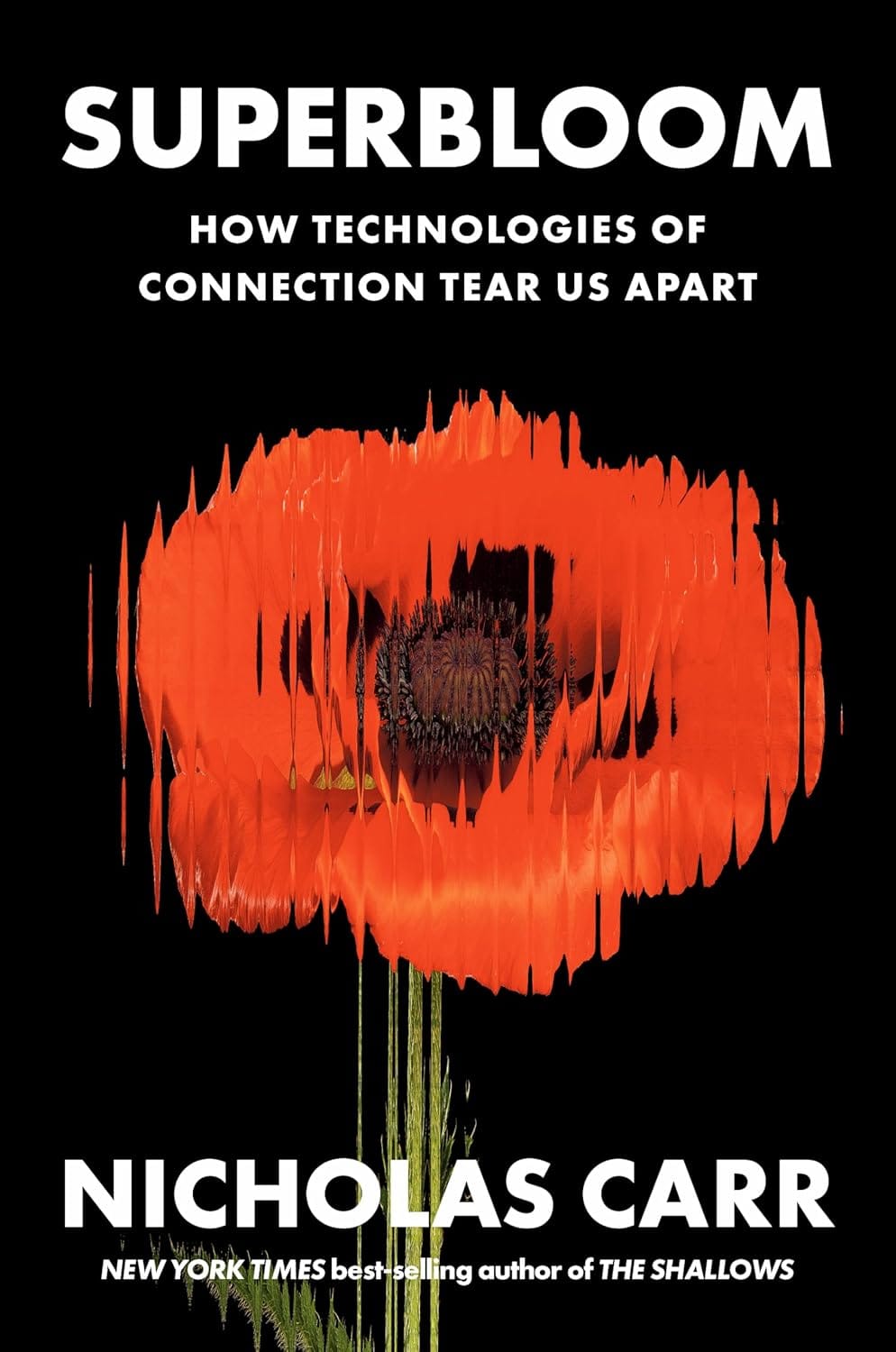
Superbloom: How Technologies of Connection Tear Us Apart is a nonfiction book by Nicholas Carr arguing that modern communication technologies—social media, algorithmic feeds, AI, and always‑online platforms—have created a hyperreality that distorts our experience of the world, corrodes empathy, and fractures democratic life.
Carr traces how each new “technology of connection” from the telegraph to TikTok promised greater proximity and understanding but instead tends to amplify confusion, conflict, and performance, while still leaving room for individual resistance through more embodied, offline forms of life. This is a fascinating history and analysis, and one of the most important concepts and strengths of the book (IMO). Herein lies the connection between my thesis of proximity, envy and the tall poppy syndrome (TPS). (More later)
Carr opens with the 2019 California poppy superbloom, when hordes of visitors descended on Walker Canyon (Lake Elsinore, California) mainly to take and share photos under the hashtag #superbloom, even trampling flowers and prompting a public safety emergency. For Carr, this episode symbolizes how digital representations (hashtags, posts, likes) now feel more real and valuable than the underlying reality, and he argues that we now live in a perpetual superbloom of information (digital poppy field) that overwhelms our limited human attention and judgment.
I am all in on California poppy superblooms and everything related to tall poppies (TP) and TPS, so I read this section with keen interest.

The book’s central concept is hyperreality: a condition in which digital simulations—feeds, images, AI content—carry more weight in our minds than direct, physical experience. Carr argues that because all forms of content now arrive through the same screens and streams, serious news, entertainment, conspiracy theories, and personal updates all compete on equal footing for engagement, rewarding whatever is most emotionally arousing rather than what is true or important. This constant competition for attention pushes platforms and users alike toward sensationalism, outrage, and virality, eroding the shared factual ground needed for democratic deliberation.
Beware of false prophets, who come to you in sheep's clothing, but inwardly are ravenous wolves. Matt 7:15 (ESV)
Carr situates today’s platforms in a longer history of communication technologies, showing that unintended harms have accompanied each wave of innovation. He discusses how the telegraph compressed time and distance, destabilizing diplomacy; how radio and early mass media aided propagandists and autocrats; and how later television and social media intensified these tendencies by rewarding spectacle and emotional manipulation. The pattern, he suggests, is that tools designed to connect people at scale often amplify division and confusion by exploiting deep-seated psychological vulnerabilities.
A joyful heart is good medicine, but a crushed spirit dries up the bones. Proverbs 17:22 (ESV)
One of Carr’s key ideas is the transformation of the self into what he calls the mirrorball self, a fragmented identity assembled from countless digital reflections and metrics. Drawing on social psychology, he argues that social media collapses the boundaries between contexts—family, work, politics, friendship—so that all audiences are present at once, forcing people into relentless self‑presentation and performance. Identity becomes something to be constantly curated for public consumption, measured by likes, followers, and engagement numbers, which, in turn, heightens anxiety, encourages conformity to group markers, and undermines a stable, coherent sense of personhood.
Lord free me of myself so I can please you. Michelangelo
Carr synthesizes research on how dense, always‑on connectivity stresses relationships rather than simply enriching them. He discusses concepts such as environmental spoiling (the more we see of others’ habits and opinions, the more we find them irritating), dissimilarity cascades (additional information highlights differences over similarities), and digital crowding (too much self‑disclosure and contact creating strain and anxiety). In his view, constant exposure to others’ curated selves and opinions makes empathy harder, encourages snap judgments, and accelerates polarization, even as platforms claim to be fostering community.
Familiarity breeds contempt.
The book argues that the hyperreal environment destabilizes traditional criteria for truth. When deepfakes, AI‑generated text, and viral misinformation blur the line between fact and fabrication, people increasingly judge information by how aesthetically pleasing or identity‑affirming it is, not by its correspondence to reality. Carr links this to the rise of conspiracy movements, partisan media ecosystems, and the broader erosion of democratic discourse, emphasizing that engagement‑driven systems reward extreme and uncanny narratives that fit group worldviews, further hardening tribal identities.
We are drowning in information, while starving for wisdom. E. O. Wilson
AI‑driven systems are tightly coupled to platforms Carr calls anti‑empathy machines, which already reduce nuance, eye contact, and sustained attention to others’ feelings. When algorithms and AI optimize for engagement, they preferentially surface content that provokes envy, anger, depression, anxiety, worsening digital crowding, polarization, and relational fatigue.
Empathy is waning in our society and the internet is part of the problem. Carr accurately describes AI-driven systems as anti-empathy machines and points out various dark emotions. We believe pinpointing and understanding these dark emotions are the first steps toward solving the problem.
Envy is the currency of social media.
Connecting the Dots.
Carr shows how social media platforms create settings that encourage self-presentation and ongoing comparison (envy). In the vast digital world of social media, we've created something never seen before in human history: a virtual field (poppy field) where everyone is visible and measurable, with their achievements and possessions always on display.
This virtual field shows how our online interactions have profoundly transformed the ancient emotion of envy and, in doing so, created ideal conditions for TPS to thrive. The psychology is simple yet powerful—envy intensifies with closeness. We're more likely to envy those close to us than distant others. However, social media has eroded the traditional barriers that once maintained psychological distance. The same screen that shows your high school friend's vacation photos also features a celebrity's lifestyle, fostering a false sense of intimacy with a much wider audience.
TPS describes a culture in which high-status individuals are resented, attacked, or criticized because they are perceived as superior to their peers. Traditionally, this tendency was restricted by geography and social groups. You might envy the neighbor with the newer car or the coworker with the corner office, but your awareness of others' success was naturally limited by physical distance and social boundaries.
Social media has completely broken down these barriers. The platforms are carefully crafted to promote self-expression through quantitative measures—follower counts, likes, shares—that turn every user into a competitor in the same arena. When everyone becomes a "media personality," they also become a TP and a target.
The collapse of traditional social boundaries online has fundamentally transformed how TPS operates. I distinguish between private TPS—the intimate cutting down that occurs within families and workplaces, and public TPS—the spectacle of bringing down high-profile figures. Social media has blurred these distinctions entirely. Every personal achievement posted online becomes a potential public target, while the most private spaces of envy now have worldwide audiences. In essence, we've democratized both the stage and the scissors.
The result is a perpetual state of comparison and resentment. As Superbloom notes, we've "dismantled all the social norms and structures that used to mitigate the risks envy posed to both personal and social well-being." The algorithm feeds our darker impulses, showing us precisely what we lack while encouraging us to broadcast our achievements, making us both the envious and the envied.
A vicious cycle is created in which success becomes a target rather than an inspiration. The very platforms designed to celebrate individual achievement become tools for cutting down those who stand too tall. We see it in the savage comment sections beneath success stories, in the gleeful sharing of others' failures, and in the tendency to find fault with anyone who dares to rise above the crowd.
Understanding the connection between digital envy and TPS is crucial for navigating our connected world. Recognizing these behaviors, both in ourselves and in our communities, is the first step toward building more supportive digital environments where success can be celebrated rather than resented and where TPs can bloom without fear of being cut down.


Tall Poppy Syndrome Newsletter
Join the newsletter to receive the latest updates in your inbox.